
On May 7, 2026, Mitsubishi UFJ Financial Group, Inc. (hereinafter referred to as MUFG) and Google announced a strategic partnership in the retail sector. They stated that they will collaborate to create new financial services and customer experiences within Japan's retail finance industry. The fact that MUFG, one of Japan's largest financial conglomerates, has teamed up with Google—often regarded as the strongest among AI giants—has an extremely significant impact. In this article, out of several key points, I would like to delve deeper, focusing particularly on AI agents.
1. Agentic Commerce and Agentic Payments
First, let's take a closer look at the release from MUFG regarding the section on AI agents (1).
Content of the Partnership (1)
Next-Generation Financial Experiences Supported by AI Agents, spanning from Purchases and Payments to Financial Transaction Decision-Making: Initiatives Toward Autonomous Finance, including Agentic Commerce / Agentic Payments
We will collaborate with an eye toward early domestic realization in the fields of "Agentic Commerce" and "Agentic Payments," where AI agents autonomously support a continuous series of processes from product selection and purchasing to payment execution.
Google Cloud plans to leverage its expertise in AI and cloud infrastructure to provide MUFG with cloud and AI technologies, as well as technical advice and development support for these initiatives.
Through this partnership, MUFG aims to build a next-generation payment infrastructure on Google Cloud to realize Agentic Commerce / Agentic Payments, striving to establish a new standard for purchasing and payments in the AI agent era in Japan.
Furthermore, by having AI agents that cooperate at a high level on this same platform support decision-making processes in daily purchases, payments, and various procedures, we aim to realize a new form of finance (autonomous finance) that gently guides customers without burdening them, while respecting their intentions.
In addition to digital channels, we will integrate physical touchpoints such as branch offices and remote consultations. By having AI agents understand and support situations across channels, we will provide a consistent sense of security and convenience, while achieving continuous support tailored to each individual customer throughout their daily lives and life events.
As shown above, this is a highly ambitious strategy. In particular, the phrase "MUFG aims to build a next-generation payment infrastructure on Google Cloud to realize Agentic Commerce / Agentic Payments, striving to establish a new standard for purchasing and payments in the AI agent era in Japan" felt like a self-declaration that they will leave other domestic competitors far behind. The following chart is a conceptual diagram of Agentic Commerce / Agentic Payments (1). Next, let's think about why MUFG chose Google.
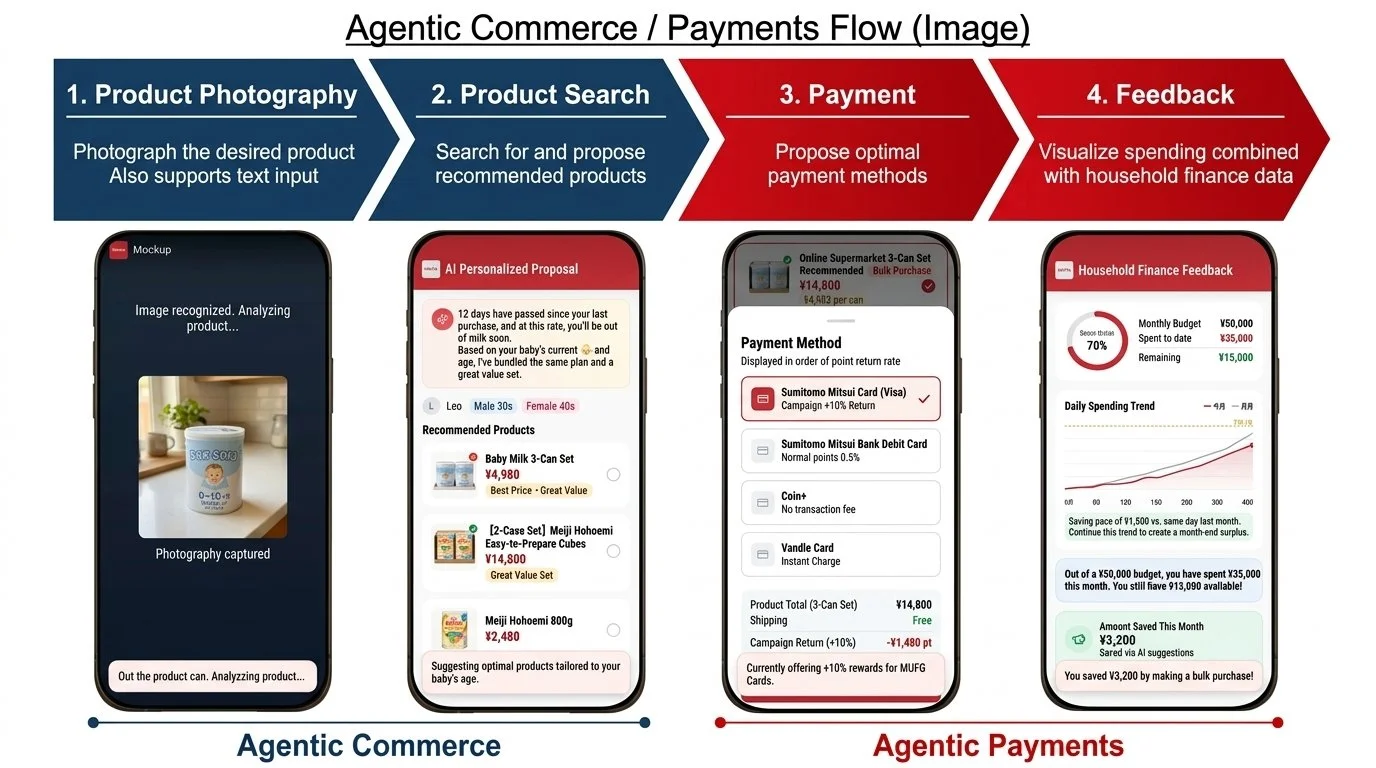
Conceptual Diagram of Agentic Commerce / Agentic Payments
2. Google’s AI Agent Protocol Suite is One of the Strongest in the World
The primary reason for MUFG choosing Google this time is presumed to be that the suite of AI agent protocols spearheaded by Google is one of the strongest in the world, making it difficult to find alternative options. Starting with the release of the Agent Development Kit (ADK, 2) in April 2025, Google has successively released AI agent protocols (communication standards) such as A2A, AP2, and UCP, expanding its partner network and leading the industry in standardization (3). In particular, the Agent Payments Protocol (AP2) is a protocol specialized for payments, which must have been highly coveted by the financial industry. Currently, each of these is evolving as open-source software, but the fact that Google is driving them is nevertheless crucial. The following material writes well about AI agent protocols. I highly recommend giving it a read (3).
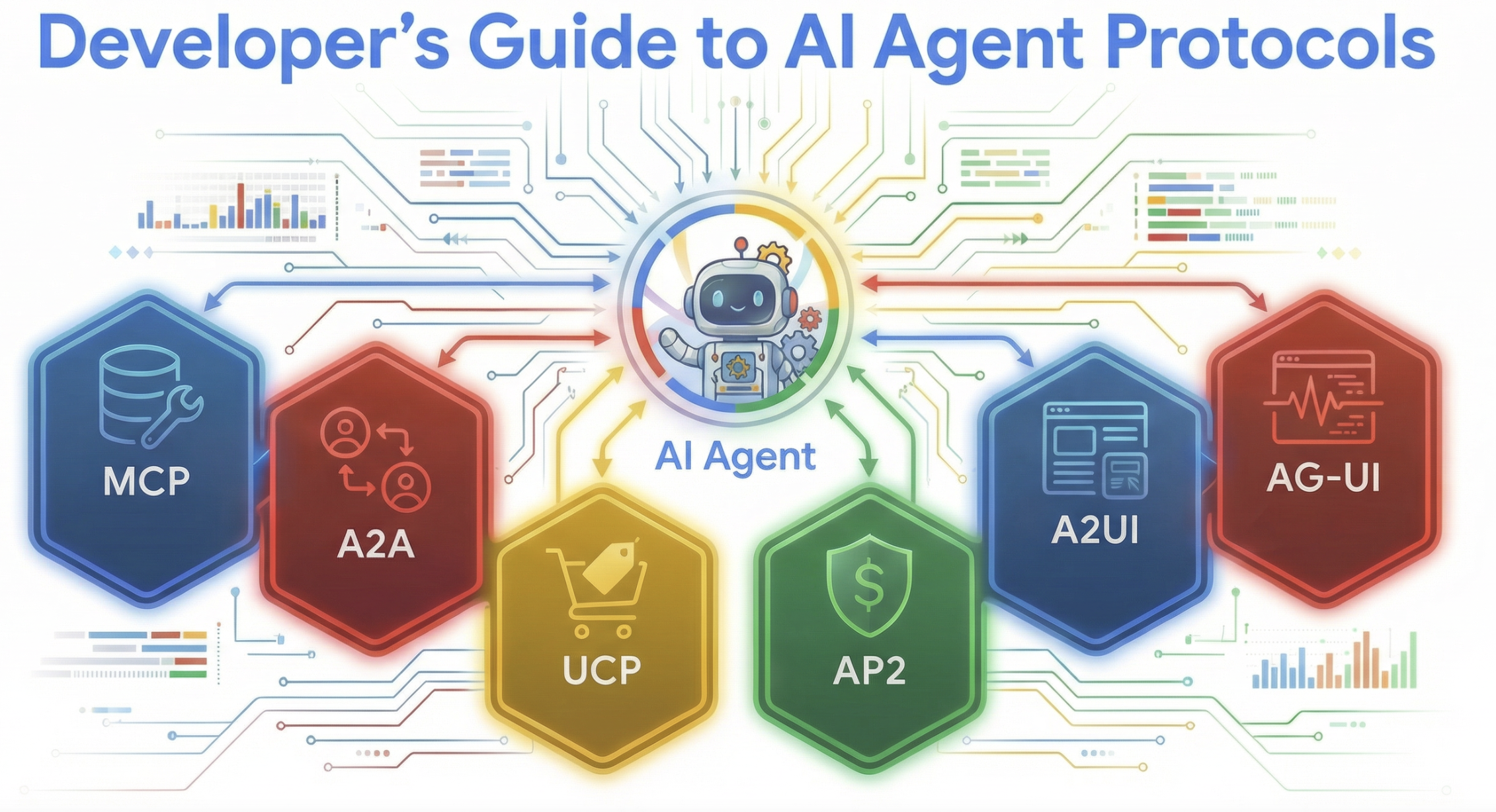
Developer’s Guide to AI Agent Protocols (3)
3. Potential for Development from the Japanese Market to the Global Market
Future developments might be easier to understand when looked at from Google’s perspective. Google knows all too well how much of a competitive advantage can be gained by securing a de facto standard in software. A prime example of this is Android, the operating system for mobile devices. Companies that want to manufacture mobile devices typically adopt Android. This is because the Android ecosystem is fully established, and even if a company were to build a proprietary system from scratch now, no partner would willingly adopt a brand-new OS. Many of you probably use mobile devices that run on Android. Through this ecosystem, Google is always able to maintain a competitive advantage in mobile devices. If they can establish a position like Android's in purchasing and payments for the AI agent era, it will bring massive benefits. Although this partnership concerns the Japanese retail market, if it succeeds in the Japanese market, expanding it as-is into the global market would be easy. This is because, inherently, there are no national borders for AI agent protocol suites. We cannot take our eyes off future developments.
What do you think? It feels like a harbinger of AI agents entering the payment market in earnest. I am very much looking forward to seeing how future financial services will change.
At ToshiStats, we will continue to think about the evolution of AI agent protocols and financial services. Look forward to it. Stay tuned!
You can enjoy our video news “ToshiStats AI Weekly Review” from this link, too!
1) Strategic Partnership between MUFG and Google in the Retail Sector, May 7, 2026, MUFG
2) Agent Development Kit (ADK)
3) Developer’s Guide to AI Agent Protocols, MARCH 18, 2026, Google
Copyright © 2026 ToshiStats Co., Ltd. All right reserved.
Notice: This is for educational purpose only. ToshiStats Co., Ltd. and I do not accept any responsibility or liability for loss or damage occasioned to any person or property through using materials, instructions, methods, algorithms or ideas contained herein, or acting or refraining from acting as a result of such use. ToshiStats Co., Ltd. and I expressly disclaim all implied warranties, including merchantability or fitness for any particular purpose. There will be no duty on ToshiStats Co., Ltd. and me to correct any errors or defects in the report, the codes and the software.