

When predicting loan defaults or customer churn using tabular data such as Excel, it is common to use linear regression models or gradient boosting models. For this purpose, it is common sense that "a prediction model must be trained first." However, on June 30, 2026, Google released TabFM (Tabular Foundation Model) (1). Astonishingly, by using this model, predictions can be executed without any training whatsoever. Is such a thing really possible? Let's dive right into the details.
1. Prediction Tasks Using Tabular Data
For predictions using tabular data, gradient boosting models like XGBoost have been commonly used. Data scientists invest their time in hyperparameter optimization and domain-specific feature engineering to extract reliable signals from the data. In competitions like Kaggle, being proficient in these techniques can be said to be the key to advancing to the top ranks. However, Google seems to be trying to change this landscape with its new foundation model, "TabFM". Google has declared the following:
“We introduce TabFM, a foundation model designed specifically for tabular data classification and regression. By framing tabular prediction as an ICL problem, TabFM eliminates the need for manual model training, hyperparameter tuning, and complex feature engineering. We are excited to share how this approach allows users to generate high-quality predictions on previously unseen tables in a single forward pass. “
To summarize, it looks like the following figure.
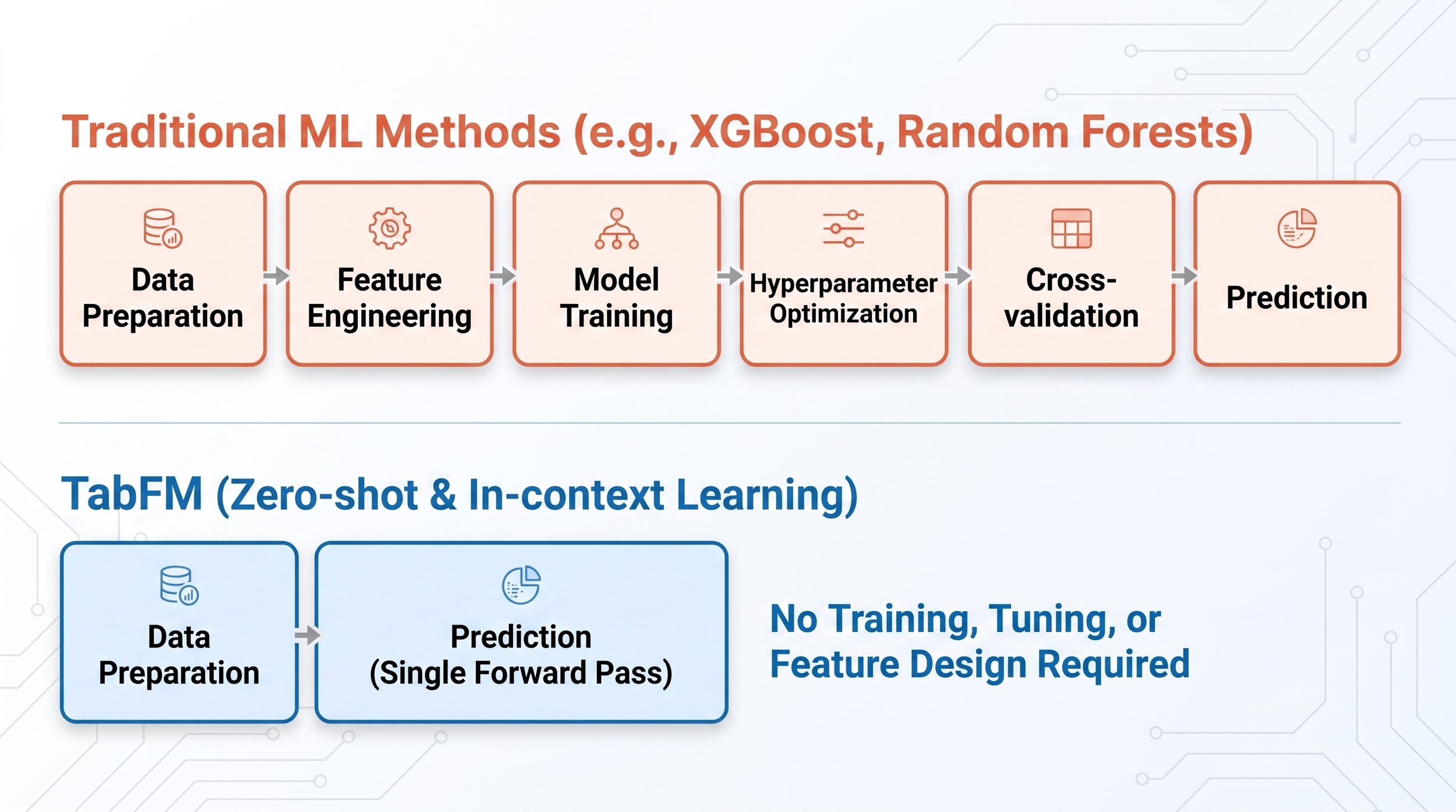
Traditional supervised learning pipeline and TabFM's zero-shot inference
Indeed, almost all the processes that were necessary up until now are no longer needed. With this, even non-data scientists might be able to tackle prediction tasks using tabular data. But is that really possible?
2. The Architecture of TabFM
How is such a feat possible? The secret seems to lie in the architecture of TabFM. The figure below illustrates this.
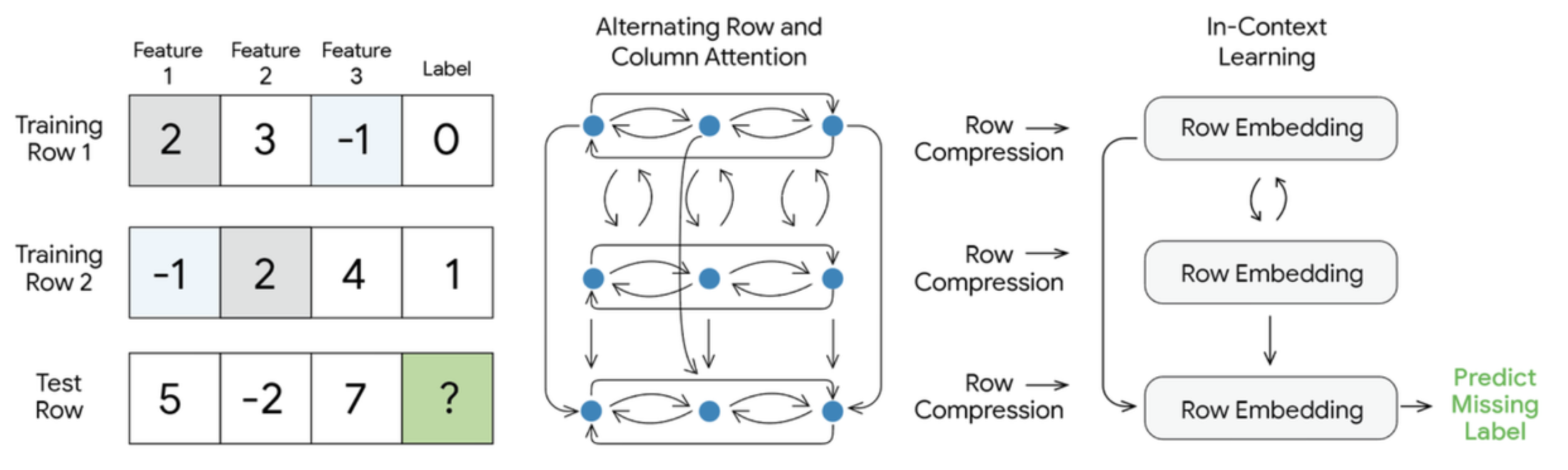
TabFM model architecture
Google explains it as follows
This architecture, visualized above, relies on three key mechanisms:
Alternating row and column attention: First, the raw table is processed through a multilayer attention module. Similar to TabPFN, this step applies alternating attention across both columns (features) and rows (examples). By continuously attending across these two dimensions, the model learns rich representations that natively capture complex feature interactions and dependencies. This deep contextualization effectively performs the heavy lifting that would otherwise require tedious manual feature crafting by data scientists.
Row compression: Following this contextualization, the rich, cross-attended information for each individual row is compressed into a single, dense vector representation.
In-context learning (ICL): Finally, a dedicated Transformer operates on this sequence of compressed embeddings. Adopting the highly efficient approach of TabICL, performing attention over these compressed row vectors — rather than the raw, uncompressed grid — drastically reduces the computation cost. This ensures the prediction step remains highly computationally efficient, even for much larger datasets.
It sounds somewhat complicated, but the bottom line is that it is "a method that applies attention across rows and columns, then compresses the rows, and finally treats the data table itself as a prompt, bringing it directly into prediction." Of course, pre-training is performed, but the data used for this is entirely synthetic. Please refer to the explanatory article for more details (1).
3. The Incredible Performance of TabFM
Now, let's take a look at TabFM's performance on the TabArena leaderboard (2). As shown below, it proudly holds the number one spot. Unfortunately, LightGBM, which I usually use, has sunk to the lower ranks. I was surprised to see such a huge gap. Since I wasn't particularly dissatisfied with LightGBM's performance, I never expected the difference to be this significant.
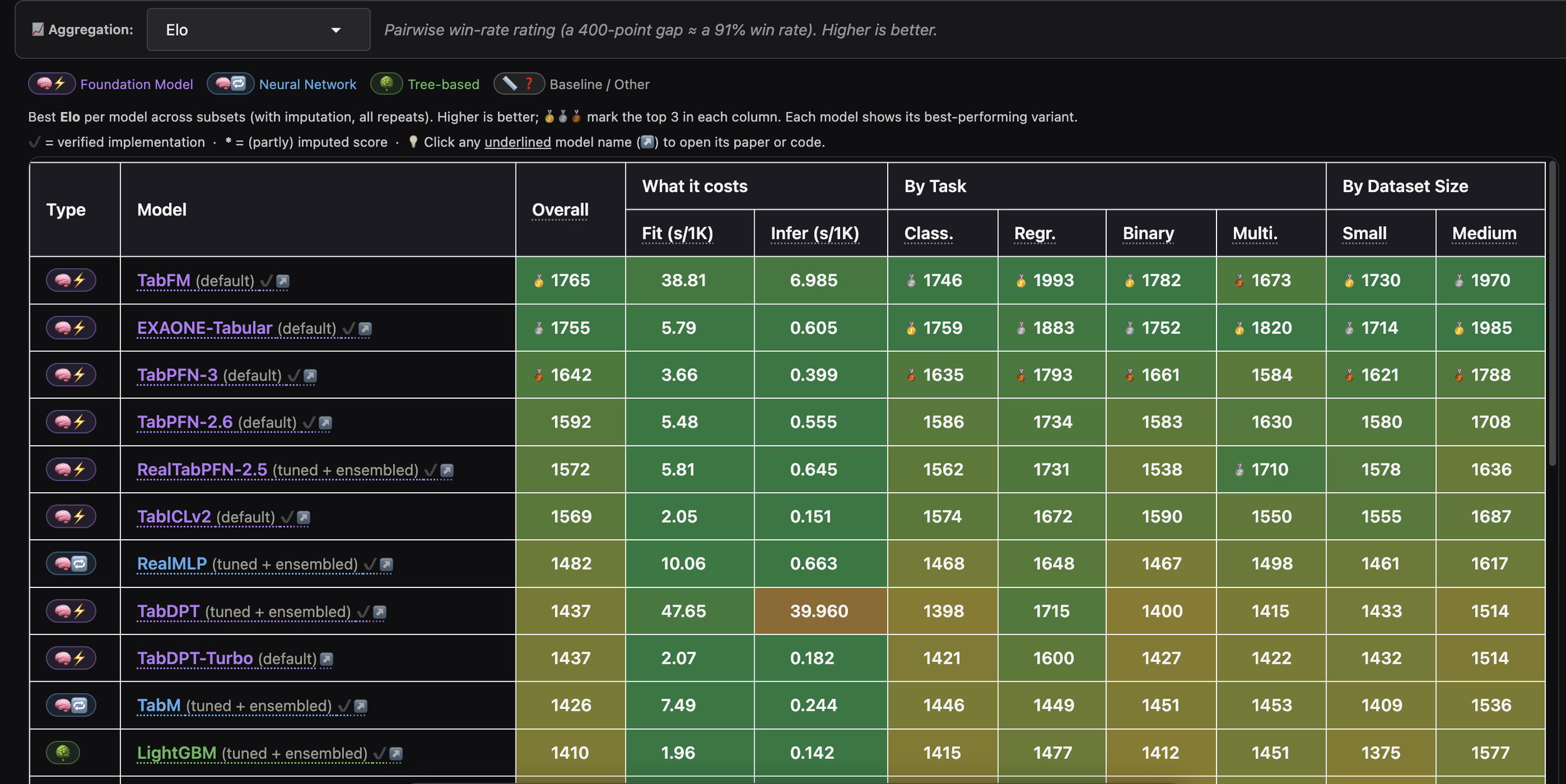
TabArena
Having been shown the performance of TabFM, I am now convinced that Google is absolutely serious about the following claim:
“This approach successfully eliminates the traditional bottlenecks of manual feature engineering, hyperparameter optimization, and repetitive model training, and consistently outperforms heavily tuned, industry-standard supervised algorithms.“
Seeing these results, I felt that a new wave of technology is approaching the realm of tabular data prediction as well.
What are your thoughts on this? This time, I introduced Google's TabFM technology, but looking at the technology more broadly, it can also be considered an application of In-Context Learning (ICL) to tabular data. In-Context Learning (ICL) is a technology cultivated within large language models, but its application might finally be expanding beyond text to various other fields. I am looking forward to seeing how it unfolds in the future. At Toshi Stats, we plan to continue challenging ourselves with the application of In-Context Learning (ICL) to tabular data. Stay tuned!
You can enjoy our video news “ToshiStats AI Weekly Review” from this link, too!
1) Introducing TabFM: A zero-shot foundation model for tabular data, Weihao Kong and Abhimanyu Das, Google Research, June 30, 2026
2)TabArena/leaderboard, Hugging Face
Copyright © 2026 ToshiStats Co., Ltd. All right reserved.
Notice: This is for educational purpose only. ToshiStats Co., Ltd. and I do not accept any responsibility or liability for loss or damage occasioned to any person or property through using materials, instructions, methods, algorithms or ideas contained herein, or acting or refraining from acting as a result of such use. ToshiStats Co., Ltd. and I expressly disclaim all implied warranties, including merchantability or fitness for any particular purpose. There will be no duty on ToshiStats Co., Ltd. and me to correct any errors or defects in the report, the codes and the software.