In-Context Learning

The Next Tabular Data Revolution: How ICL Delivers Accurate Predictions from Minimal Rows

Hello everyone. Another exciting week with multiple new generative AI models launched!

Yet, there is an interesting observation: most generative AI models are trained primarily on text-based data, and their capabilities are predominantly benchmarked against text-centric tasks such as coding. In contrast, tabular data—which dominates day-to-day enterprise operations—has seen comparatively little discussion in this space. Recently, however, several startups have started releasing dedicated generative AI foundation models for tabular data as open-weight models. Today, we focus on a numerical regression task to explore the true potential of this paradigm.


1. Nori V1 and How It Works

The foundation model highlighted today is Nori V1, developed by Synthefy. Synthefy is a high-momentum startup that recently closed a fresh funding round (1). Their website describes the release as follows:

"Nori V1 is the open-weight foundation model for tables. Apache 2.0 code and weights, free for commercial use."

The secret behind its high accuracy is In-Context Learning (ICL), a topic touched upon previously. In terms of data pipeline, context is constructed by assembling labeled training data and presenting it to the model upfront to set up the baseline for inference. Next, the test data intended for prediction is provided.

In practice, both the training and test sets are bundled into a single massive prompt fed directly into Nori V1 to run inference. In this benchmark, the objective is predicting house prices—a standard regression task.
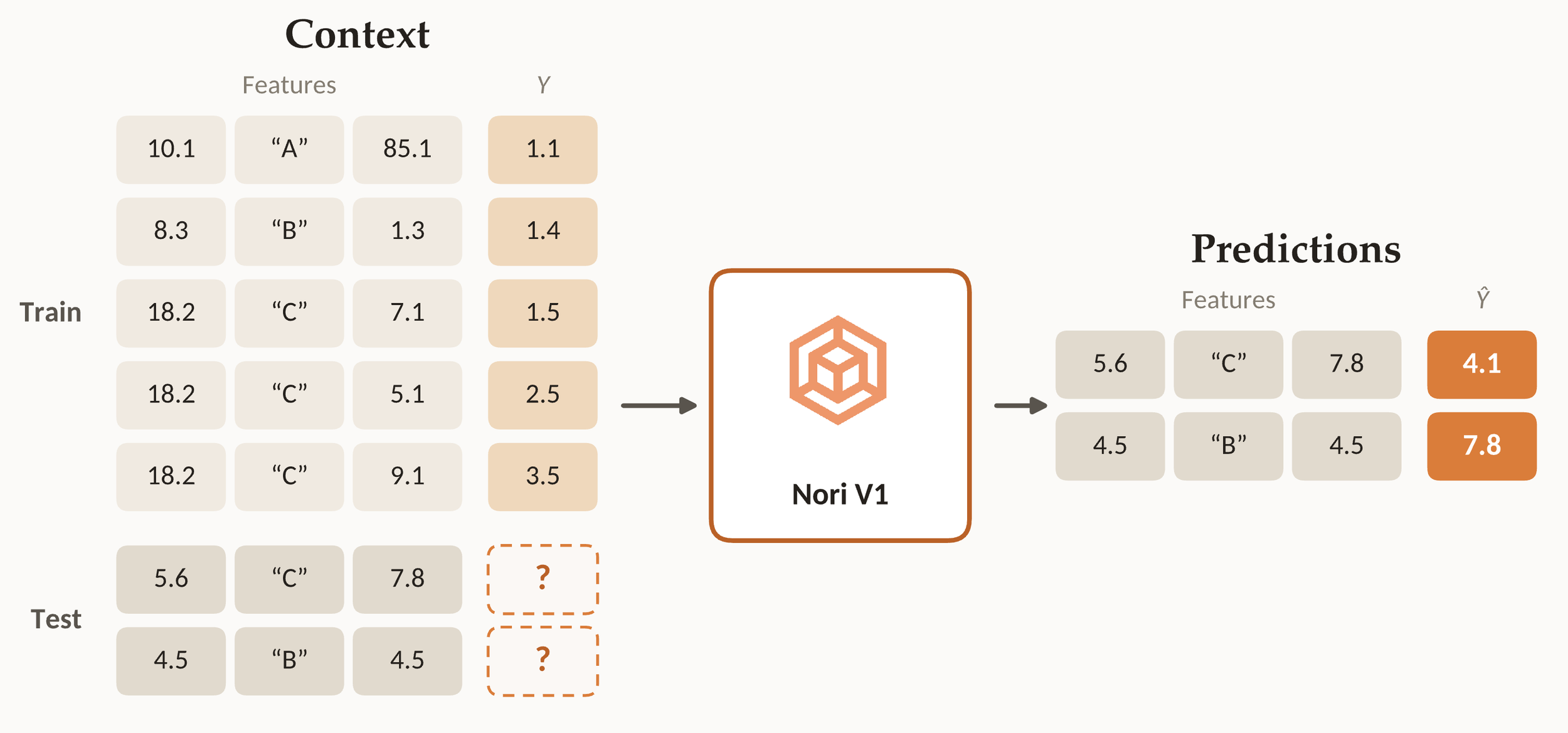
               In-Context Learning (ICL)

The defining characteristic of ICL is that it operates entirely out-of-the-box with zero fine-tuning required. This makes it accessible even to non-specialists. But does it truly maintain competitive accuracy? Let’s test it against real-world data.


2. Benchmarking Nori V1 on Kaggle Data

Accuracy was validated using a Kaggle benchmark: With 79 explanatory variables describing (almost) every aspect of residential homes in Ames, Iowa, this competition challenges you to predict the final price of each home. (2).

An overview of the dataset is provided below. With only 1,460 samples, this is hardly sufficient for training a machine learning prediction model. Let's see what level of accuracy can be achieved with a sample size like this.

‍  ‍             Overview of the Competition Data

I evaluated the model's accuracy ceiling using 1,000 training samples and submitted the predictions to the Kaggle leaderboard. At the time of submission, the result placed 43rd out of 3,138 entries—within the top 1.4%—an outstanding outcome. Because no training was required, the process simply involved feeding the "1,000 reference samples + test data" into the model and submitting the output. It achieved the ideal balance: remarkable simplicity paired with high predictive accuracy.
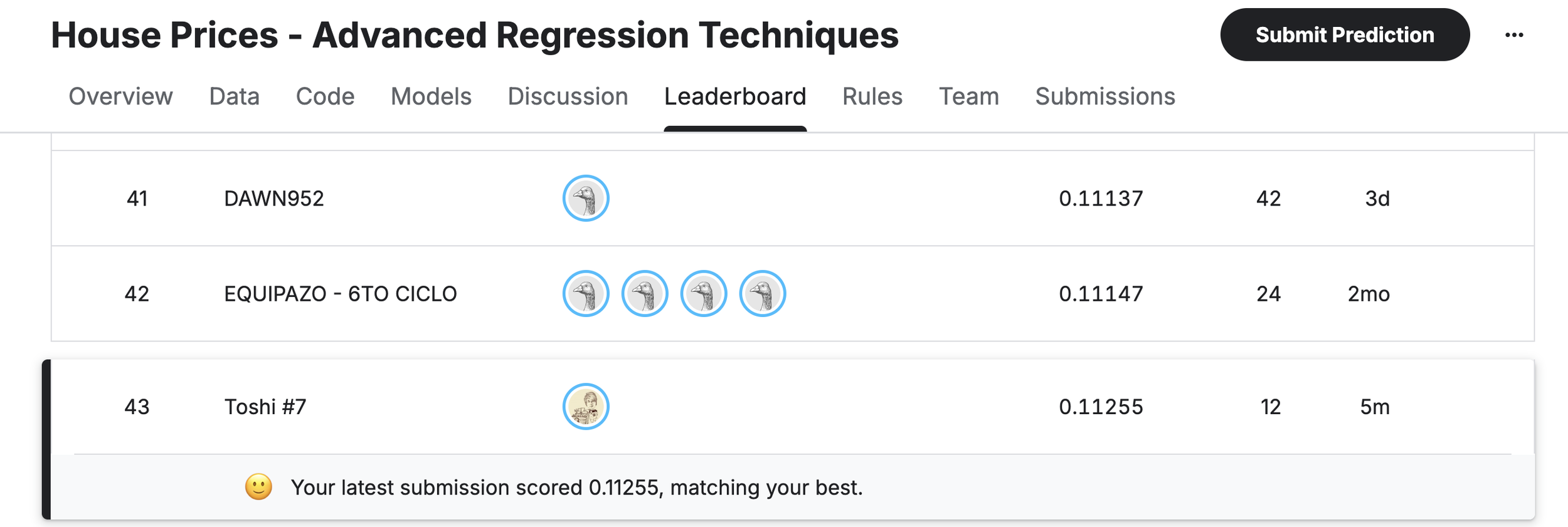
The result placed 43rd out of 3,138 entries—within the top 1.4%.

With a modest total of 1,460 samples, conventional gradient boosting libraries like LightGBM often face constraints from data scarcity. In these low-sample regimes, Nori V1 proved remarkably effective.


3. Use Case: Tackling the Cold-Start Problem

If foundation models can deliver high predictive accuracy on scarce tabular data, the most immediate application is resolving the cold-start problem. In client consulting engagements, a frequent blocker is: "We are still accumulating data, so predictive modeling is off the table until our database grows."

With an ICL foundation model like Nori V1, teams can begin running predictions immediately on whatever preliminary data is available, driving earlier data-backed operational decisions across initiatives such as:

  • Launching new products or services

  • Entering new regional markets

  • Targeting uncharted customer segments

Where decision-makers previously had to rely on intuition due to limited baseline records, ICL tabular models provide a grounded foundation for rational decision-making from day one.

To wrap up, a quote from Synthefy captures the broader ambition:

"We are building Machine Intelligence for the class of decisions humans could never make at all."

At ToshiStats, we will continue pushing the boundaries of In-Context Learning (ICL) across tabular data science. Stay tuned!

You can enjoy our video news “ToshiStats AI Weekly Review” from this link, too!


1) Building Foundation Models for the World's Structured Data, August 18 2026, Synthefy
2) House Prices - Advanced Regression Techniques, kaggle

Copyright © 2026 ToshiStats Co., Ltd. All right reserved.

Notice: This is for educational purpose only. ToshiStats Co., Ltd. and I do not accept any responsibility or liability for loss or damage occasioned to any person or property through using materials, instructions, methods, algorithms or ideas contained herein, or acting or refraining from acting as a result of such use. ToshiStats Co., Ltd. and I expressly disclaim all implied warranties, including merchantability or fitness for any particular purpose. There will be no duty on ToshiStats Co., Ltd. and me to correct any errors or defects in the report, the codes and the software.

Exploring Tabular ICL: High-Precision Prediction Models for Small Datasets

Recently, I've been hearing a lot about models that perform tabular prediction using ICL (In-Context Learning). In addition to Google TabFM, which I introduced last time, several startups have also released ICL models. Therefore, I would like to compare them with LightGBM, a machine learning model I frequently use, to see where their strengths lie. Let's dive right into the details.


1. Applying ICL (In-Context Learning) to Tabular Data

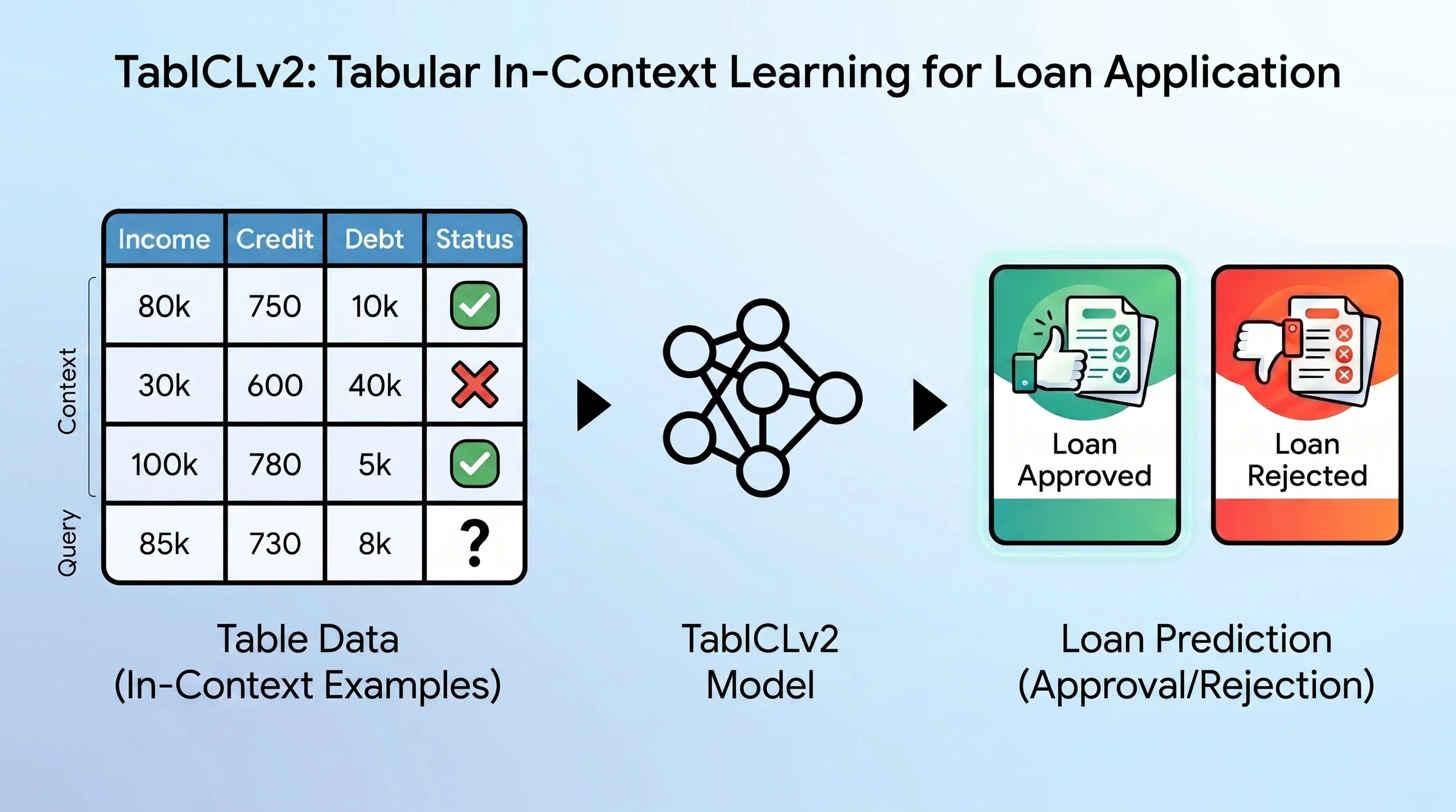
The selling point of ICL models is that they can be used straight out of the box without training. The chart below should make this specifically easier to understand.

‍  ‍      Applying ICL (In-Context Learning) to Tabular Data

First, regarding the input data, the context is key. This involves gathering data with already known outcomes and showing it to the model beforehand to prepare it for prediction. Next, the samples (queries) for the actual prediction are input, and the prediction is executed. In reality, as shown in the diagram, the context and the samples (queries) are combined and input into the ICL model as one large prompt. Since we will be predicting approval or rejection based on loan application data this time (3), it will be a binary classification prediction task. Now, let's actually experiment with some data.


2. Comparison between ICL Models and LightGBM

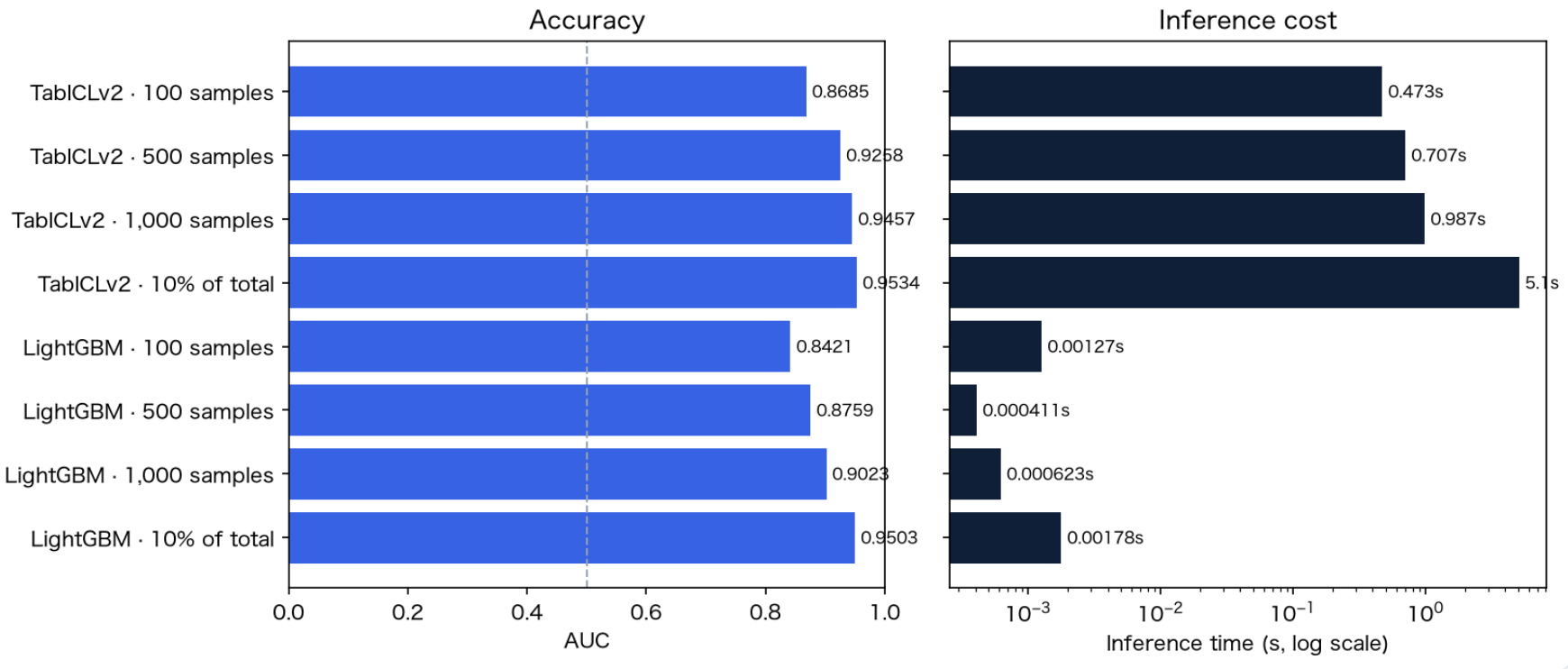
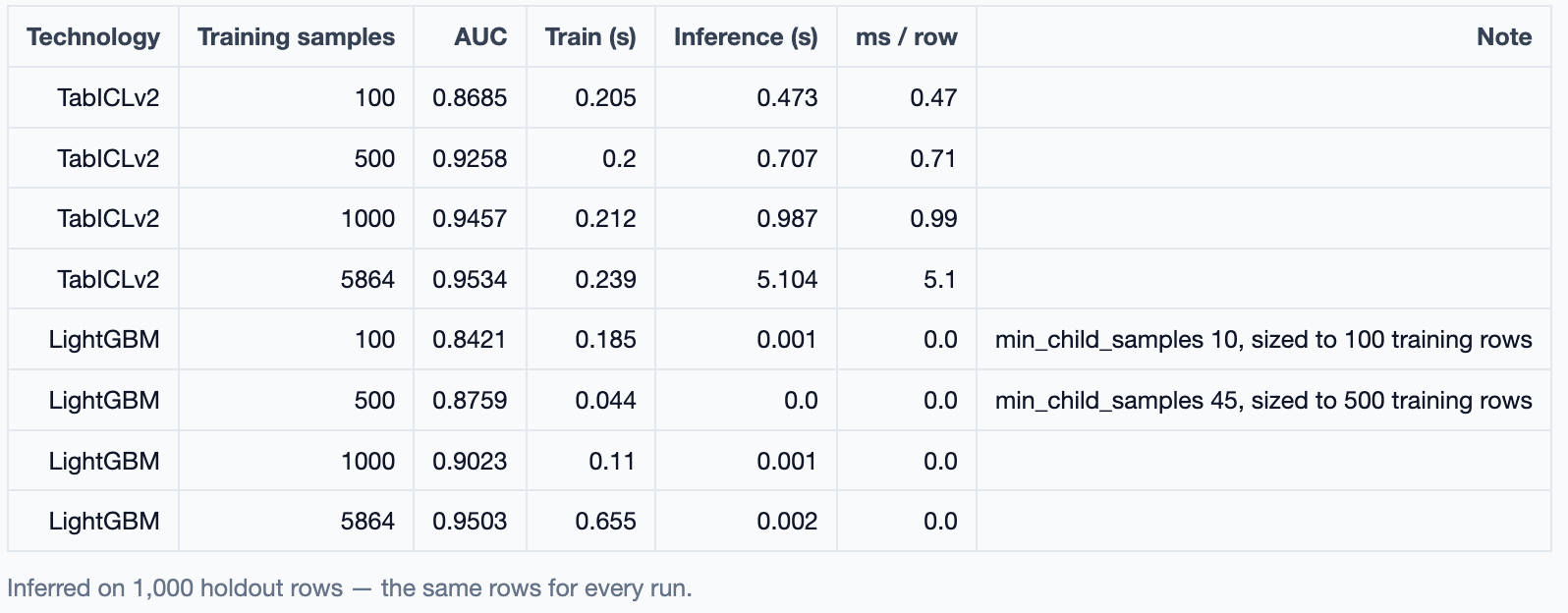
For this experiment, I used a model called TabICLv2 (1). It is lightweight, easy to use, and its availability under the BSD 3-Clause License is also appealing. I compared it with LightGBM (2), a gradient boosting machine learning model. I have been using LightGBM as my first-choice model for over five years. I'm excited to see how close TabICLv2 can get to this LightGBM. By the way, the hardware used this time is a MacBook Air M4 with 24GB of RAM. The results are as follows:

‍  ‍             TabICLv2 vs LightGBM

The most noticeable thing is the high accuracy of TabICLv2 with a training dataset of only 100 samples. While LightGBM requires model training before prediction, with 1,000 samples or fewer, the training data was simply too small, causing it to fall behind TabICLv2. The high accuracy with a small number of samples is due to the fact that TabICLv2 is a foundation model and has been thoroughly pre-trained. Because it possesses the necessary information for prediction from the start, it can predict without any issues even with a small number of samples. It's amazing!

‍  ‍               TabICLv2 vs LightGBM

However, in terms of cost (computation time), LightGBM has the advantage. When performing ICL (In-Context Learning) with TabICLv2, you end up inputting a large amount of context every time you make a prediction. If the context is around 1,000 samples, there is no particular problem in practice, but at 5,000 samples, the computation time becomes noticeable. Also, this time, the number of prediction samples is fixed at 1,000. In actual business operations, it often exceeds 10,000, so it is presumed that TabICLv2 would be difficult to use in cases requiring real-time processing.


3. When Should You Use an ICL Model?

Based on the above experimental results, I recommend trying out ICL models in the following cases:

  • When you want to execute predictions with a small amount of data on hand      The situation of "not being able to do anything until data accumulates" is often called the cold start problem. Immediately after launching a new product in finance, naturally, there is no data. In such cases, managing credit risk used to be difficult, but it seems ICL models can resolve this issue.

  • When there are no data analysis experts                     Training models like LightGBM still requires specialized knowledge. If you do not have such talent in-house, an ICL model, which completely eliminates the training process, becomes a reliable asset.

Conversely, if you have abundant data and data scientists in-house, LightGBM seems to have the upper hand. After all, having the right tool for the right job is important.


What did you think? Various new ICL-type models are being released, and I'm looking forward to future developments. At Toshi Stats, we plan to continue exploring the application of In-Context Learning (ICL) to tabular data. Stay tuned!


You can enjoy our video news “ToshiStats AI Weekly Review” from this link, too!

1) TabICLv2: A better, faster, scalable, and open tabular foundation model, Jingang Qu, David Holzmüller, Gaël Varoquaux, Marine Le Morvan, Feb 11, 2026
2) LightGBM, Microsoft Corporation
3) Loan Approval Prediction,  kaggle, Oct 1, 2024

Copyright © 2026 ToshiStats Co., Ltd. All right reserved.

Notice: This is for educational purpose only. ToshiStats Co., Ltd. and I do not accept any responsibility or liability for loss or damage occasioned to any person or property through using materials, instructions, methods, algorithms or ideas contained herein, or acting or refraining from acting as a result of such use. ToshiStats Co., Ltd. and I expressly disclaim all implied warranties, including merchantability or fitness for any particular purpose. There will be no duty on ToshiStats Co., Ltd. and me to correct any errors or defects in the report, the codes and the software.
Deep Dive into TabFM: Is Google's New Foundation Model a Game-Changer for Tabular Data?

When predicting loan defaults or customer churn using tabular data such as Excel, it is common to use linear regression models or gradient boosting models. For this purpose, it is common sense that "a prediction model must be trained first." However, on June 30, 2026, Google released TabFM (Tabular Foundation Model) (1). Astonishingly, by using this model, predictions can be executed without any training whatsoever. Is such a thing really possible? Let's dive right into the details.


1. Prediction Tasks Using Tabular Data

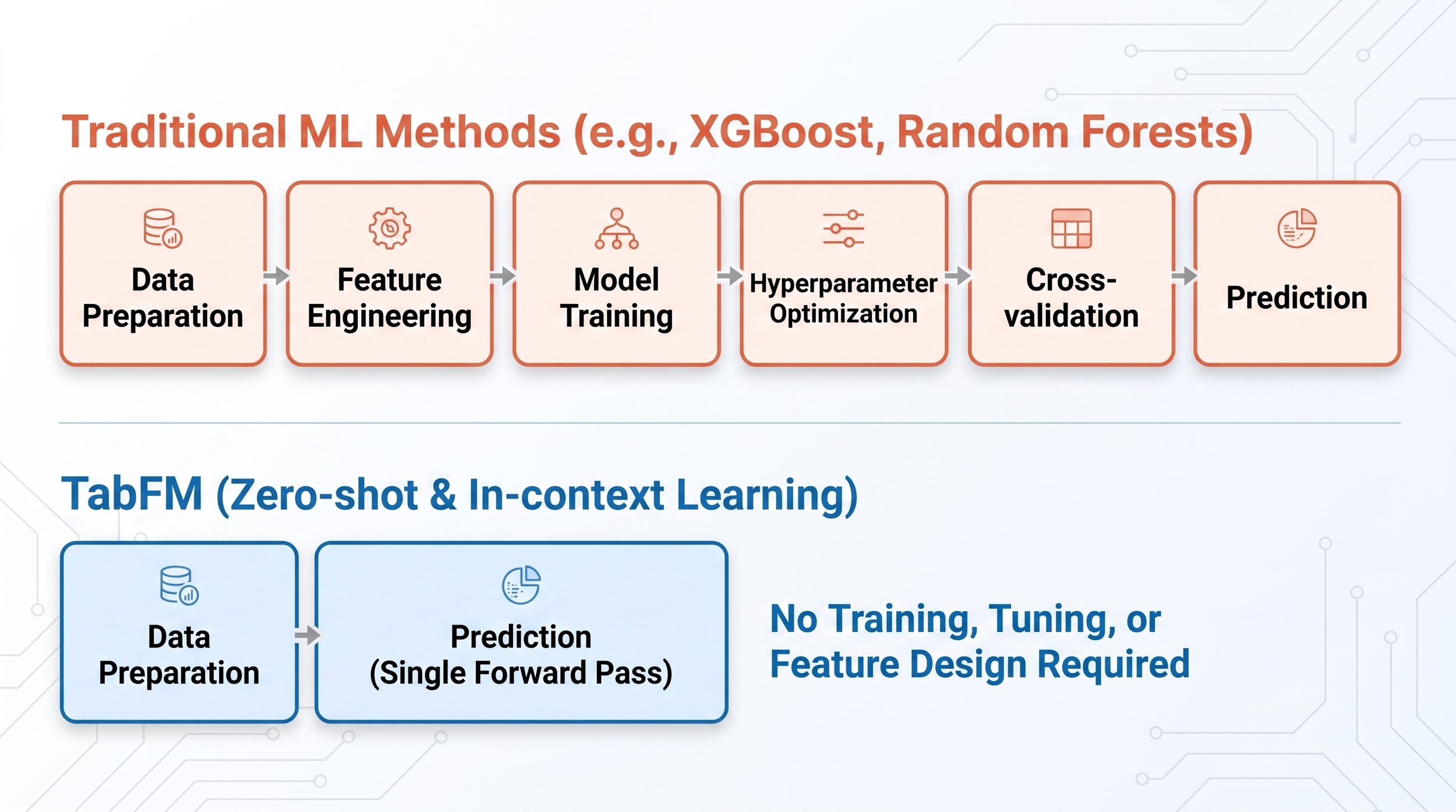
For predictions using tabular data, gradient boosting models like XGBoost have been commonly used. Data scientists invest their time in hyperparameter optimization and domain-specific feature engineering to extract reliable signals from the data. In competitions like Kaggle, being proficient in these techniques can be said to be the key to advancing to the top ranks. However, Google seems to be trying to change this landscape with its new foundation model, "TabFM". Google has declared the following:

“We introduce TabFM, a foundation model designed specifically for tabular data classification and regression. By framing tabular prediction as an ICL problem, TabFM eliminates the need for manual model training, hyperparameter tuning, and complex feature engineering. We are excited to share how this approach allows users to generate high-quality predictions on previously unseen tables in a single forward pass. “

To summarize, it looks like the following figure.

      Traditional supervised learning pipeline and TabFM's zero-shot inference

Indeed, almost all the processes that were necessary up until now are no longer needed. With this, even non-data scientists might be able to tackle prediction tasks using tabular data. But is that really possible?


2. The Architecture of TabFM

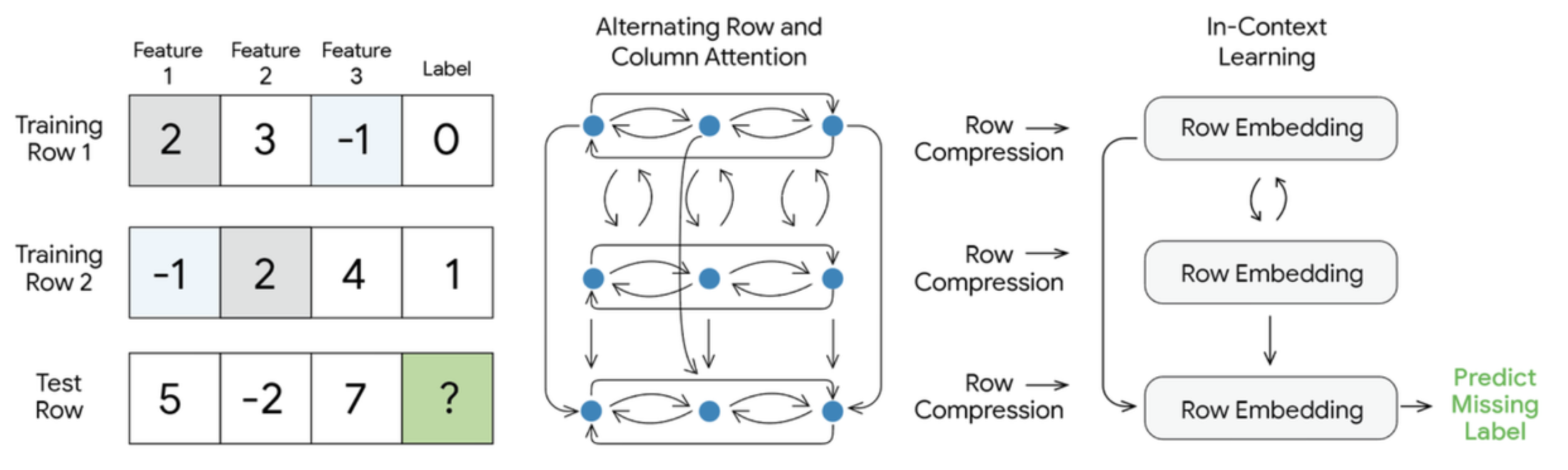
How is such a feat possible? The secret seems to lie in the architecture of TabFM. The figure below illustrates this.

            TabFM model architecture

Google explains it as follows

This architecture, visualized above, relies on three key mechanisms:

  • Alternating row and column attention: First, the raw table is processed through a multilayer attention module. Similar to TabPFN, this step applies alternating attention across both columns (features) and rows (examples). By continuously attending across these two dimensions, the model learns rich representations that natively capture complex feature interactions and dependencies. This deep contextualization effectively performs the heavy lifting that would otherwise require tedious manual feature crafting by data scientists.

  • Row compression: Following this contextualization, the rich, cross-attended information for each individual row is compressed into a single, dense vector representation.

  • In-context learning (ICL): Finally, a dedicated Transformer operates on this sequence of compressed embeddings. Adopting the highly efficient approach of TabICL, performing attention over these compressed row vectors — rather than the raw, uncompressed grid — drastically reduces the computation cost. This ensures the prediction step remains highly computationally efficient, even for much larger datasets.

It sounds somewhat complicated, but the bottom line is that it is "a method that applies attention across rows and columns, then compresses the rows, and finally treats the data table itself as a prompt, bringing it directly into prediction." Of course, pre-training is performed, but the data used for this is entirely synthetic. Please refer to the explanatory article for more details (1).


3. The Incredible Performance of TabFM

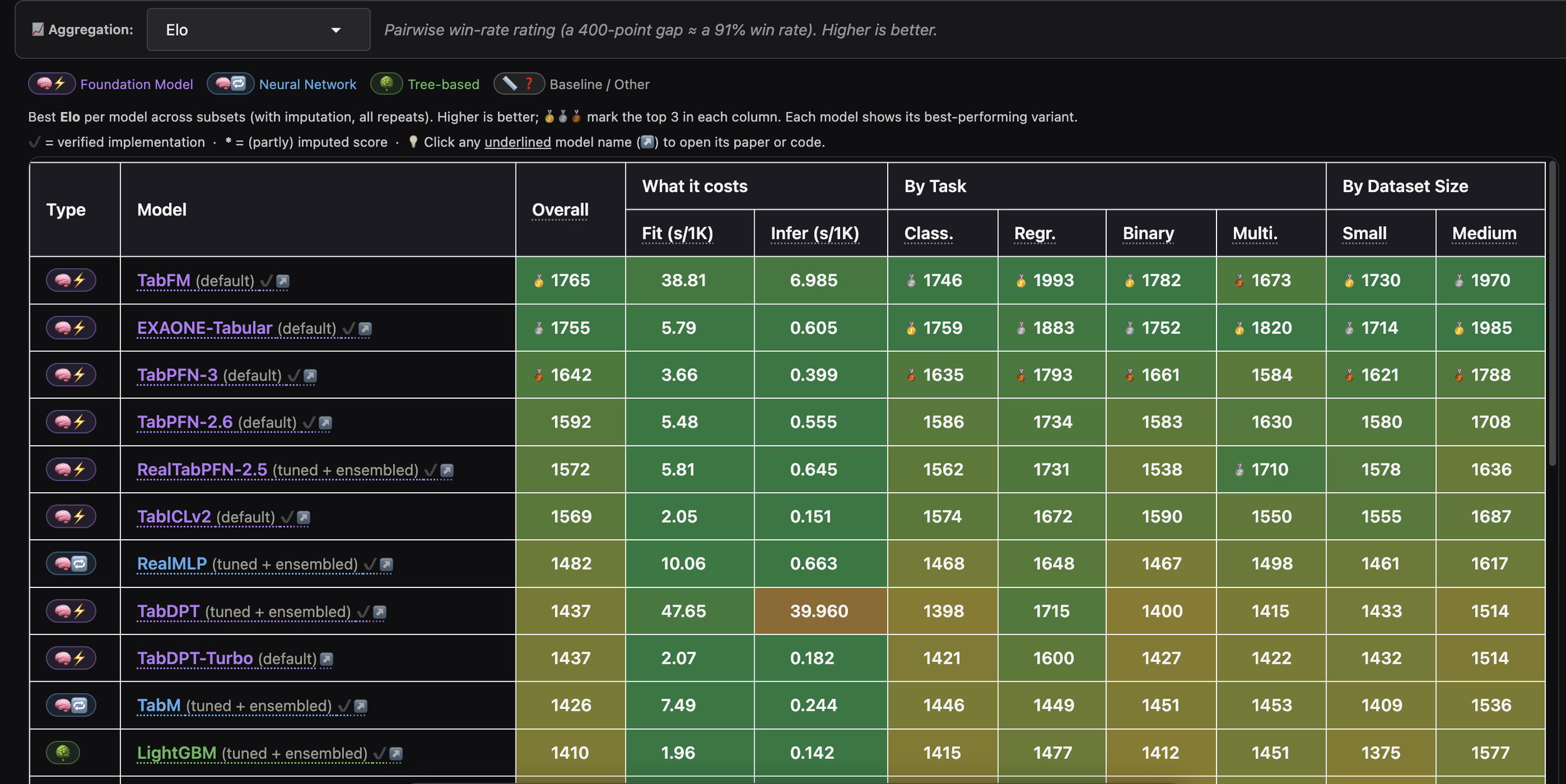
Now, let's take a look at TabFM's performance on the TabArena leaderboard (2). As shown below, it proudly holds the number one spot. Unfortunately, LightGBM, which I usually use, has sunk to the lower ranks. I was surprised to see such a huge gap. Since I wasn't particularly dissatisfied with LightGBM's performance, I never expected the difference to be this significant.

                  TabArena

Having been shown the performance of TabFM, I am now convinced that Google is absolutely serious about the following claim:

“This approach successfully eliminates the traditional bottlenecks of manual feature engineering, hyperparameter optimization, and repetitive model training, and consistently outperforms heavily tuned, industry-standard supervised algorithms.“

Seeing these results, I felt that a new wave of technology is approaching the realm of tabular data prediction as well.


What are your thoughts on this? This time, I introduced Google's TabFM technology, but looking at the technology more broadly, it can also be considered an application of In-Context Learning (ICL) to tabular data. In-Context Learning (ICL) is a technology cultivated within large language models, but its application might finally be expanding beyond text to various other fields. I am looking forward to seeing how it unfolds in the future. At Toshi Stats, we plan to continue challenging ourselves with the application of In-Context Learning (ICL) to tabular data. Stay tuned!


You can enjoy our video news “ToshiStats AI Weekly Review” from this link, too!

1) Introducing TabFM: A zero-shot foundation model for tabular data, Weihao Kong and Abhimanyu Das, Google Research, June 30, 2026
2)TabArena/leaderboard,  Hugging Face


Copyright © 2026 ToshiStats Co., Ltd. All right reserved.

Notice: This is for educational purpose only. ToshiStats Co., Ltd. and I do not accept any responsibility or liability for loss or damage occasioned to any person or property through using materials, instructions, methods, algorithms or ideas contained herein, or acting or refraining from acting as a result of such use. ToshiStats Co., Ltd. and I expressly disclaim all implied warranties, including merchantability or fitness for any particular purpose. There will be no duty on ToshiStats Co., Ltd. and me to correct any errors or defects in the report, the codes and the software.
Many-Shot In-Context Learning: The Game Changer of the Long-Context AI Era

Recently, OpenAI released its newest AI model, GPT-5.4 (1). While much of the praise has focused on its overall performance, I want to highlight its context window length. The context window refers to the amount of information a generative AI can process in a single go. GPT-5.4 now supports 1M (one million) tokens. With its rival Opus 4.6 also at 1M and Google Gemini having achieved 1M two years ago, all frontier models from the "Big Three" now possess 1M-token context windows. We can officially say that AI has entered the Long-Context Era.

How will this impact the development of AI agents? Let’s explore.


1. What is Many-Shot In-Context Learning?

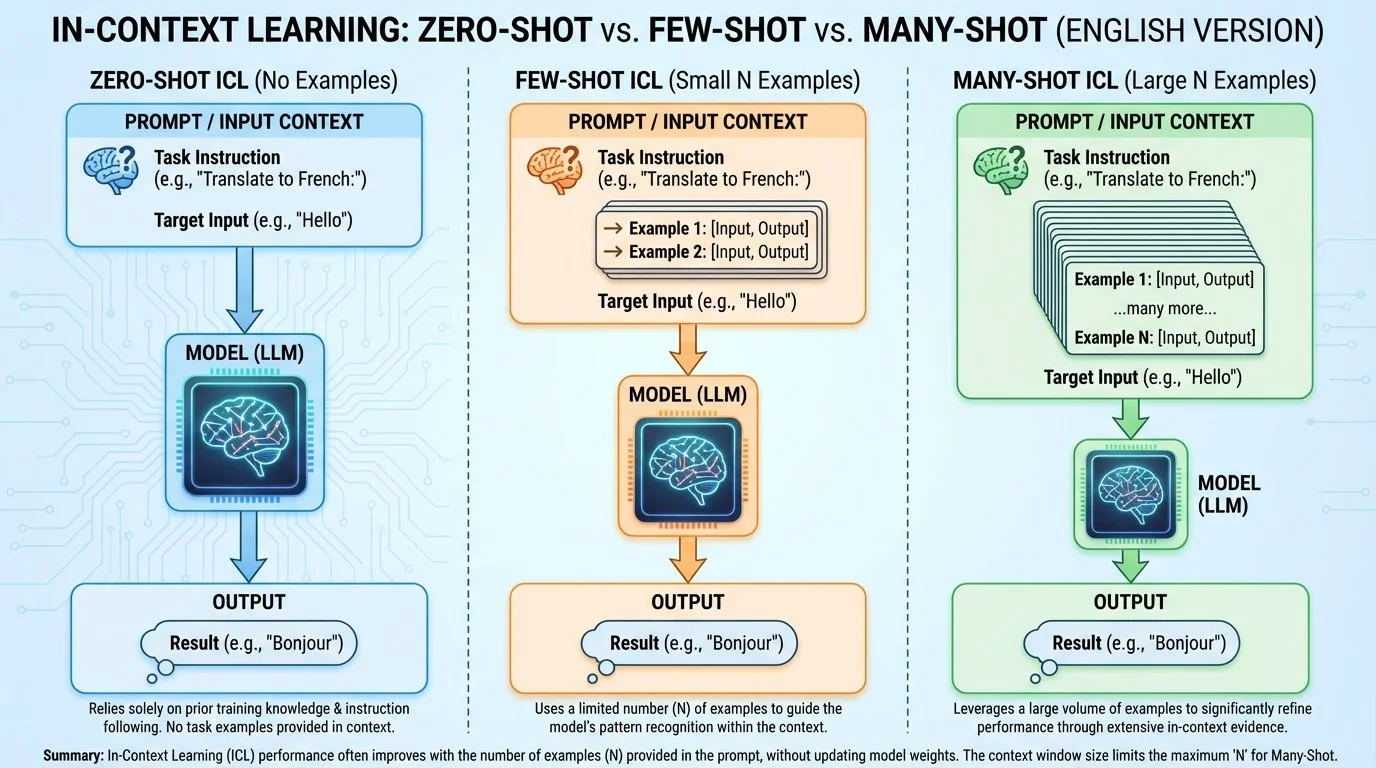
When you ask ChatGPT, "What is the capital of Japan?" and it replies, "Tokyo," that question or instruction is called a prompt. However, you can input much more than just a short prompt.

For example, if you provide examples first—such as "Where was the World Expo held in Japan?" followed by "Osaka"—and then ask your actual question, the accuracy is known to improve. This technique is called In-Context Learning. When the number of examples exceeds roughly 10 and you provide a massive amount of data, it is referred to as Many-Shot In-Context Learning. Here is a brief summary.

In-Context Learning


2. Challenging a 20-Class Classification Task Using Bank Complaint Data

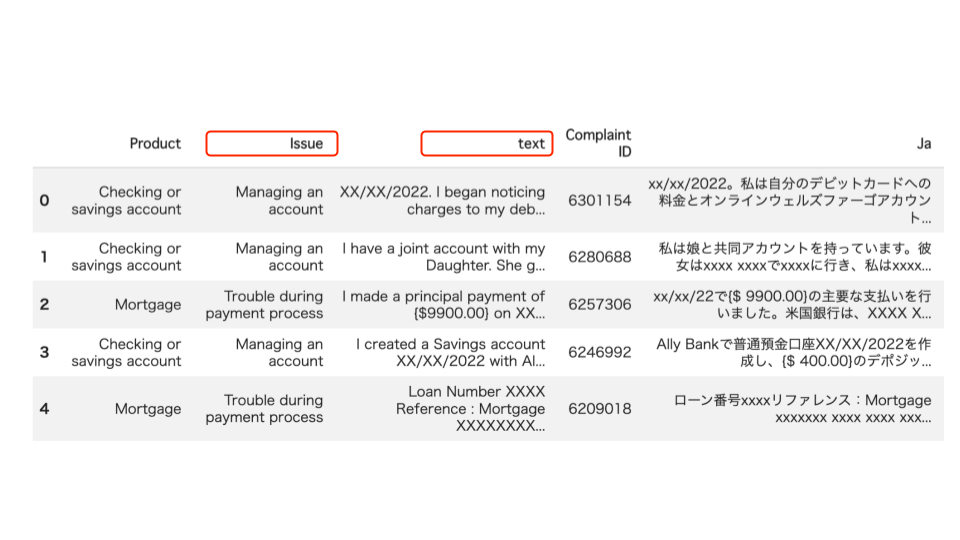
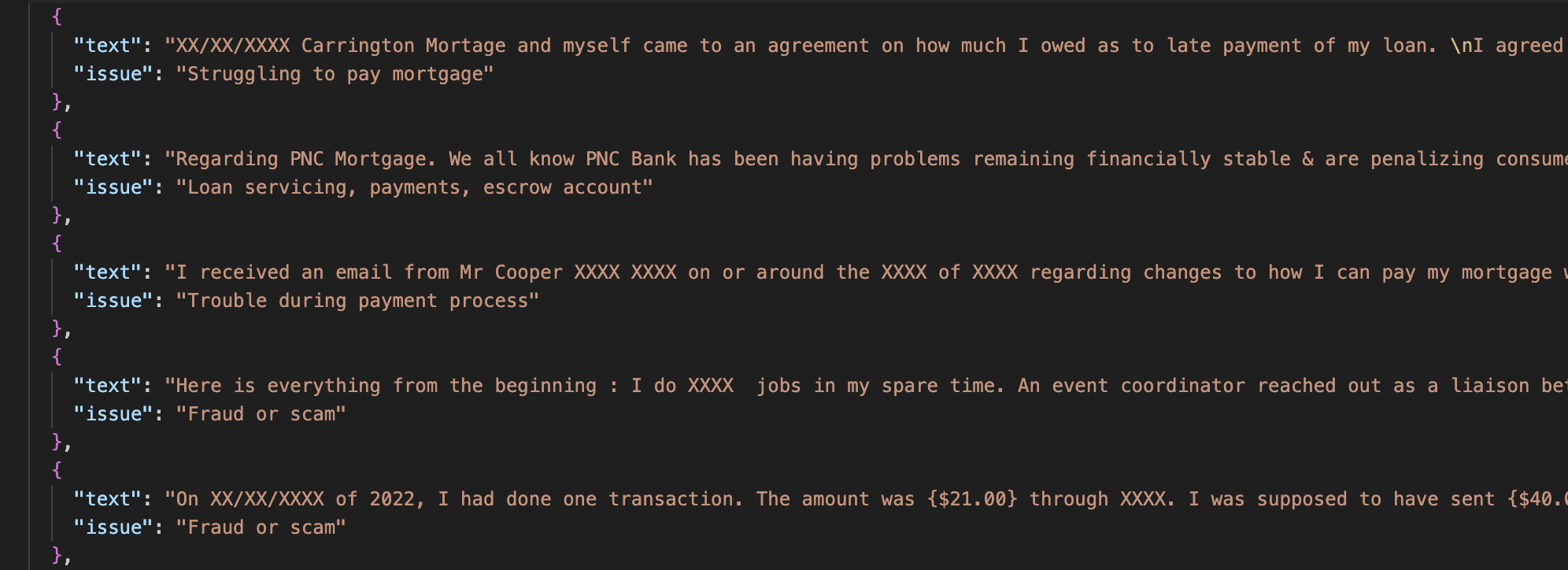
To measure the effectiveness of Many-Shot In-Context Learning, I decided to tackle a difficult 20-class classification task using bank complaint data (2). This dataset contains an "issue" column describing why a complaint occurred. The goal is to read the "text" column and select the correct cause from 20 possible categories. For this, I used Gemini 3.1 Flash-Lite (3).

     Banking complaints dataset

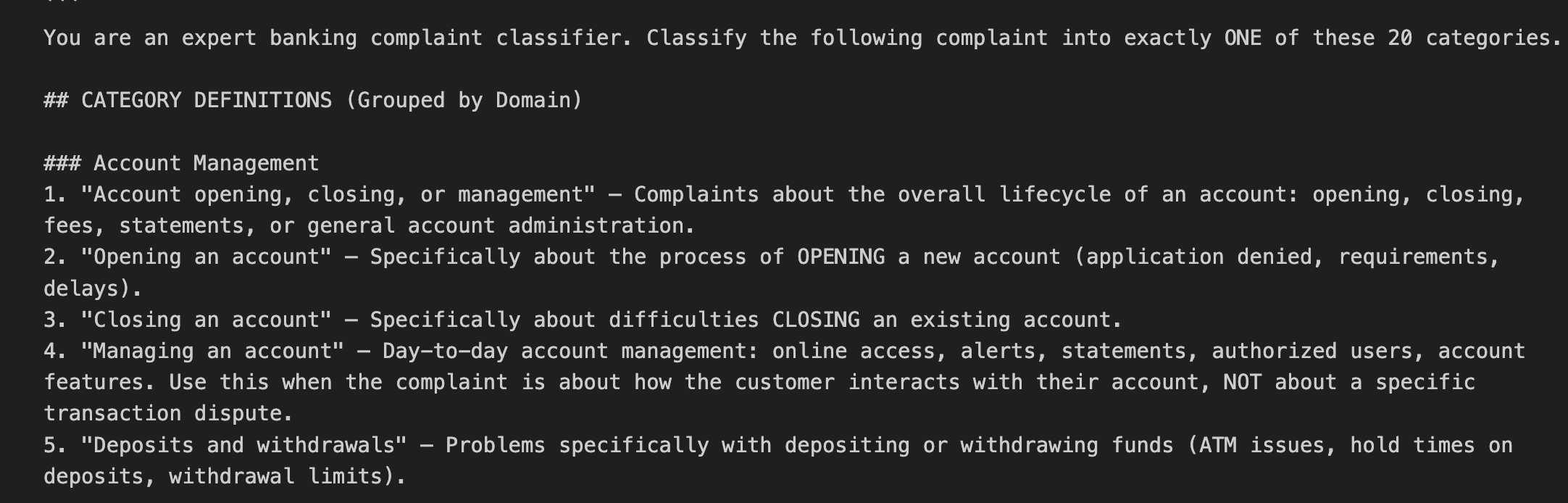
Rather than using a simple prompt like "Please classify this," I asked the AI itself to "create the optimal prompt," resulting in a highly detailed set of instructions—what you might call a "Prompt Powered by AI."

prompt powered by AI

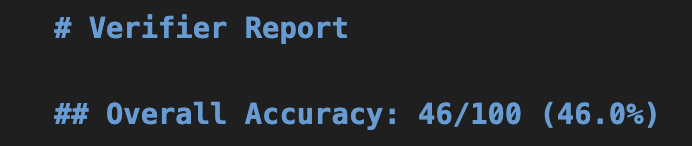
I first attempted this using Zero-shot (providing no examples), even with this enhanced prompt. Unfortunately, the accuracy was only 46%. Since it gets it wrong more than half the time, it isn't yet viable for practical business use.

Zero-Shot accuracy


3. Executing Many-Shot In-Context Learning with 1,000 Samples

Next, I implemented Many-Shot In-Context Learning by providing 1,000 examples alongside the prompt. While the underlying process remains the same as the Zero-shot approach, the volume of information is massive. The following are the first five examples.

Many-Shot samples

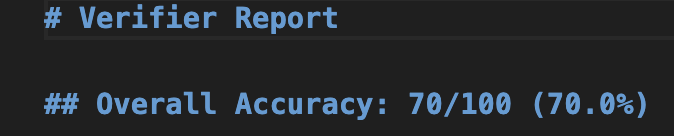
The results were dramatic: accuracy jumped to 70%. This clearly demonstrates the sheer power of the "Many-Shot" approach.

Many-Shot accuracy

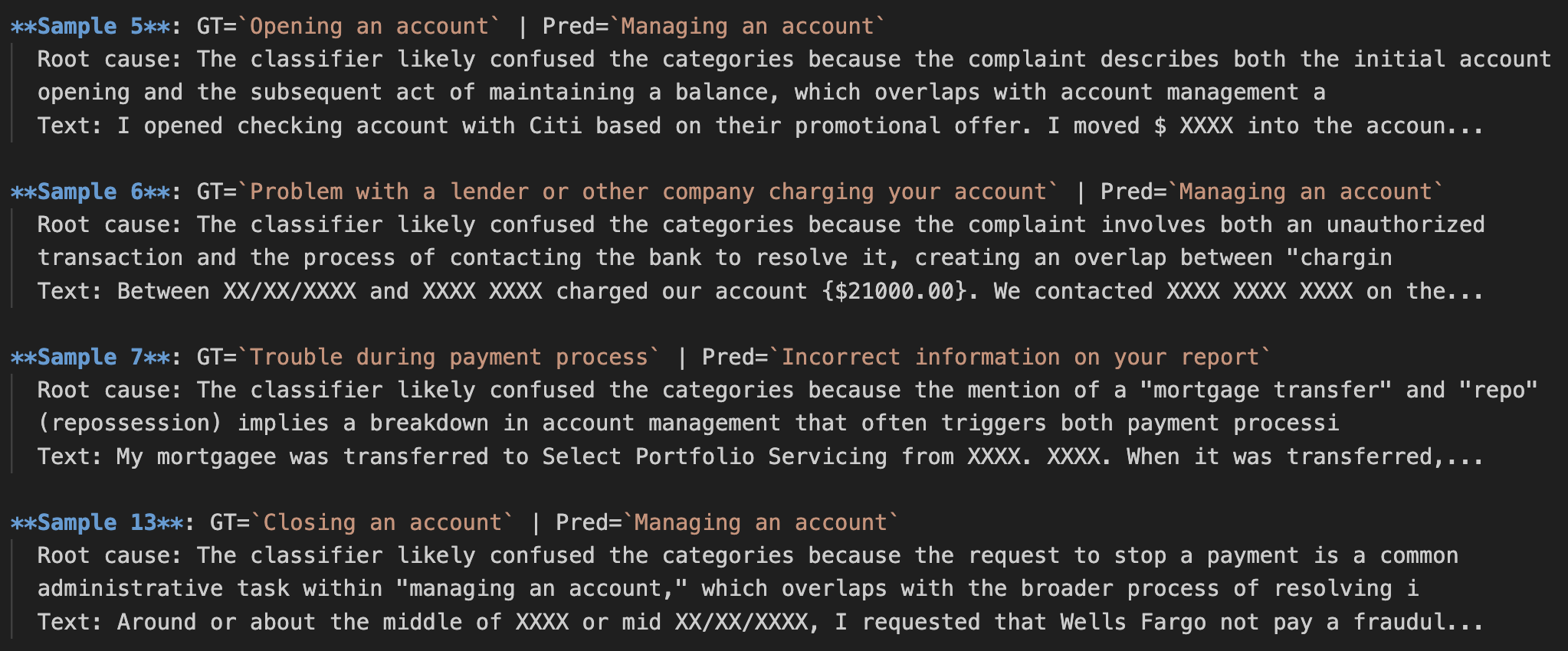
However, with a 30% error rate, there is still room for improvement. I had an AI Agent analyze why the errors occurred and generate a report. The insights gained from this analysis are highly valuable for further refinement.

Root cause analysis


Conclusion

There are several ways to improve the accuracy of generative AI, but as 1M-token context windows become the standard, Many-Shot In-Context Learning is set to become a major focal point. At ToshiStats, we plan to continue evolving this methodology.

Stay tuned!

You can enjoy our video news ToshiStats AI Weekly Review from this link, too!


1) Introducing GPT‑5.4, Open AI, March 5, 2026
2) Consumer Complaint Database
3 )Gemini 3.1 Flash-Lite: Built for intelligence at scale, Google, Mar 03, 2026

Copyright © 2026 ToshiStats Co., Ltd. All right reserved.

Notice: This is for educational purpose only. ToshiStats Co., Ltd. and I do not accept any responsibility or liability for loss or damage occasioned to any person or property through using materials, instructions, methods, algorithms or ideas contained herein, or acting or refraining from acting as a result of such use. ToshiStats Co., Ltd. and I expressly disclaim all implied warranties, including merchantability or fitness for any particular purpose. There will be no duty on ToshiStats Co., Ltd. and me to correct any errors or defects in the report, the codes and the software.