

Chinese AI models have been making remarkable leaps forward, and on August 26, 2026, a new AI was announced by Alibaba Cloud (1). It is called "Qwen3.8-Flash-Next," and it's touted to surpass the frontier model Opus4.6. Furthermore, its outstanding technology will reportedly be directly carried over to the next-generation Qwen4. Let's take a look right away!
1. Features of "Qwen3.8-Flash-Next"
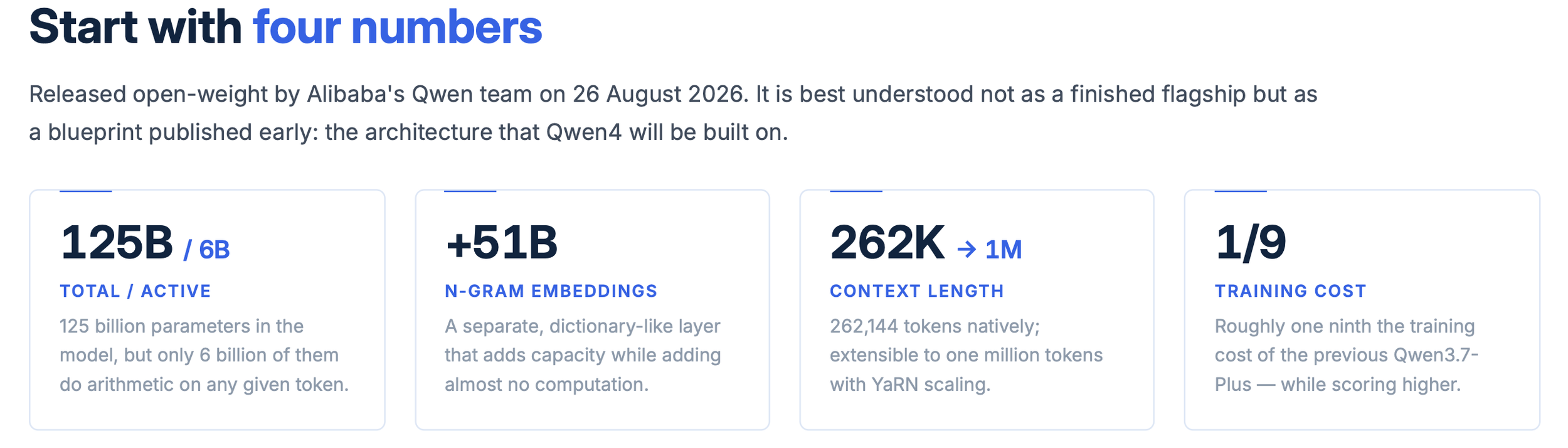
This model is a medium-scale AI model with 125 billion parameters. It adopts MoE (Mixture of Experts), and the actual active parameters are extremely small at 6 billion. Therefore, the calculation speed is presumed to be very fast. The context window is also large at 262,000 tokens, and it seems it can even be expanded to 1 million tokens. Compared to the previous generation model, the training cost is supposedly only 1/9th, making it a highly super-efficient model. However, it's a wonder how it manages to surpass Opus4.6 with a parameter count that is by no means massive. Let's explore the secret behind this.
2. Core Technology of "Qwen3.8-Flash-Next"
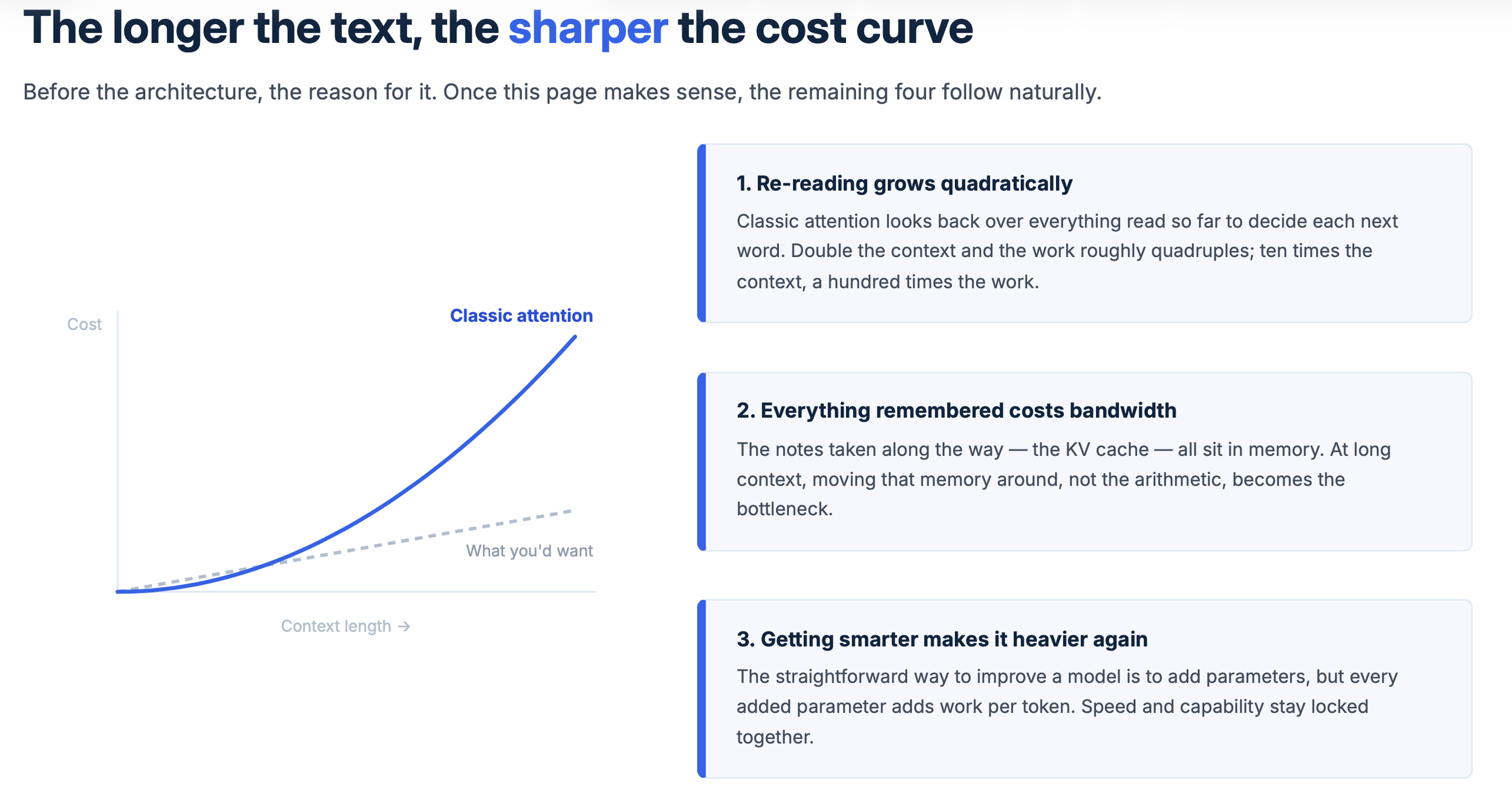
First, it is often said that to improve AI accuracy, the size must be increased. The wall developers hit there is that as the information to process increases, the AI suddenly becomes heavy. The main issue lies in the "attention mechanism" used by most AIs. This is a mechanism that calculates "how much attention should be paid to which information" while the data advances through each layer, but the sheer volume of calculation is massive. Wishing to "do something about this," Alibaba researchers seem to have applied great ingenuity to the "attention mechanism."
Here is the overall structural diagram of Qwen3.8-Flash-Next.
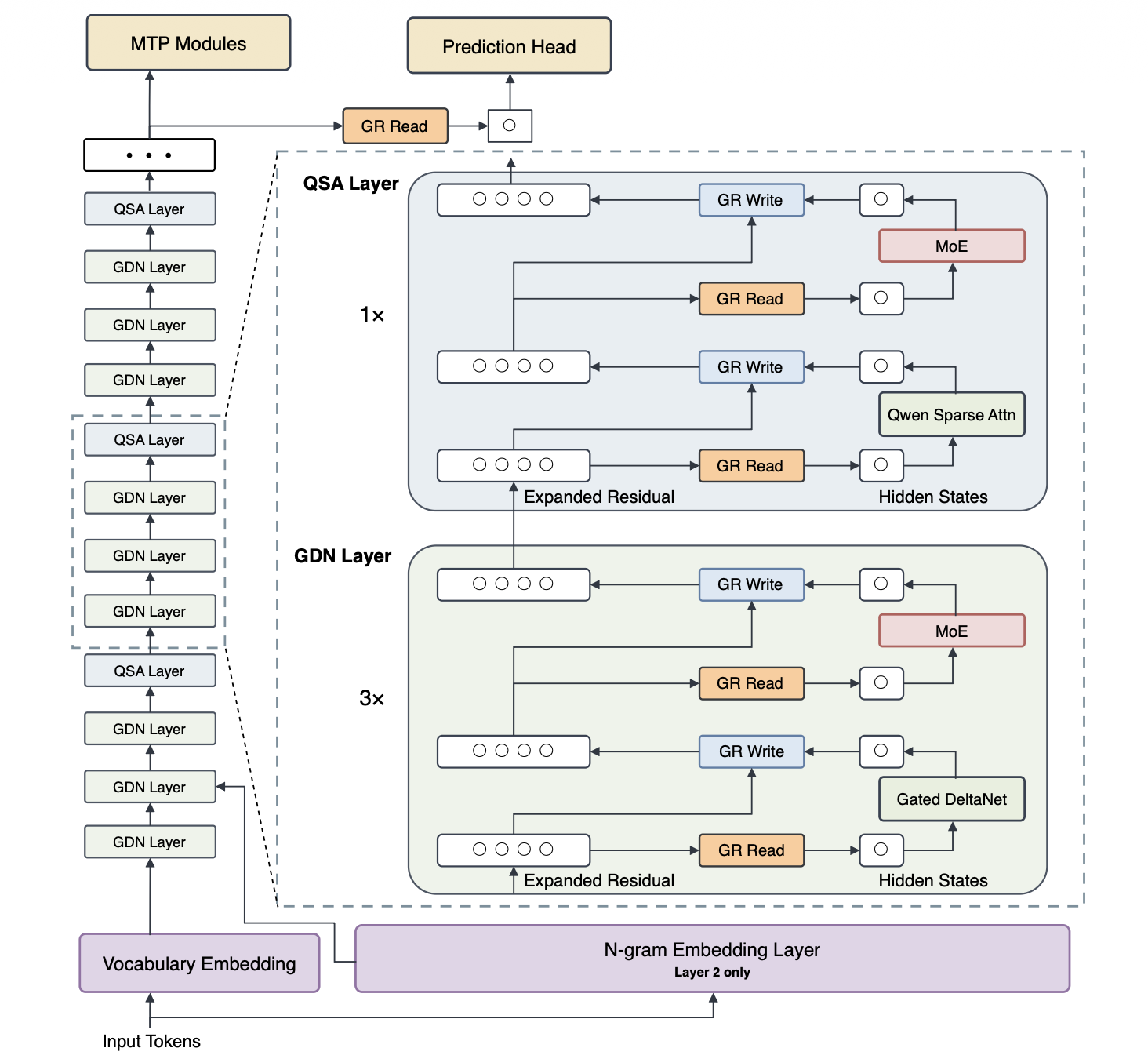
Qwen3.8-Flash-Next
First, let's look at the attention mechanism. It has a structure of 48 layers in total, consisting of 12 sets of GDN (Gated DeltaNet) and QSA (Qwen Sparse Attention) in a 3:1 ratio. I think this exquisite combination is absolutely brilliant.
Now, I will explain GDN and QSA. To prevent calculations from becoming too heavy while maintaining accuracy, GDN features a mechanism where the computational volume doesn't increase significantly even if the length of the input tokens increases. That is wonderful, but as a trade-off, there are inevitably cases where accuracy drops. Thus, QSA is used to prevent this decline in accuracy. Normally, a method called "full attention," which looks at every single token, is used, but it has the drawback of bloated computational costs. Therefore, QSA keeps computational costs down by using a method of briefly skimming once, and then reading closely on the second pass.
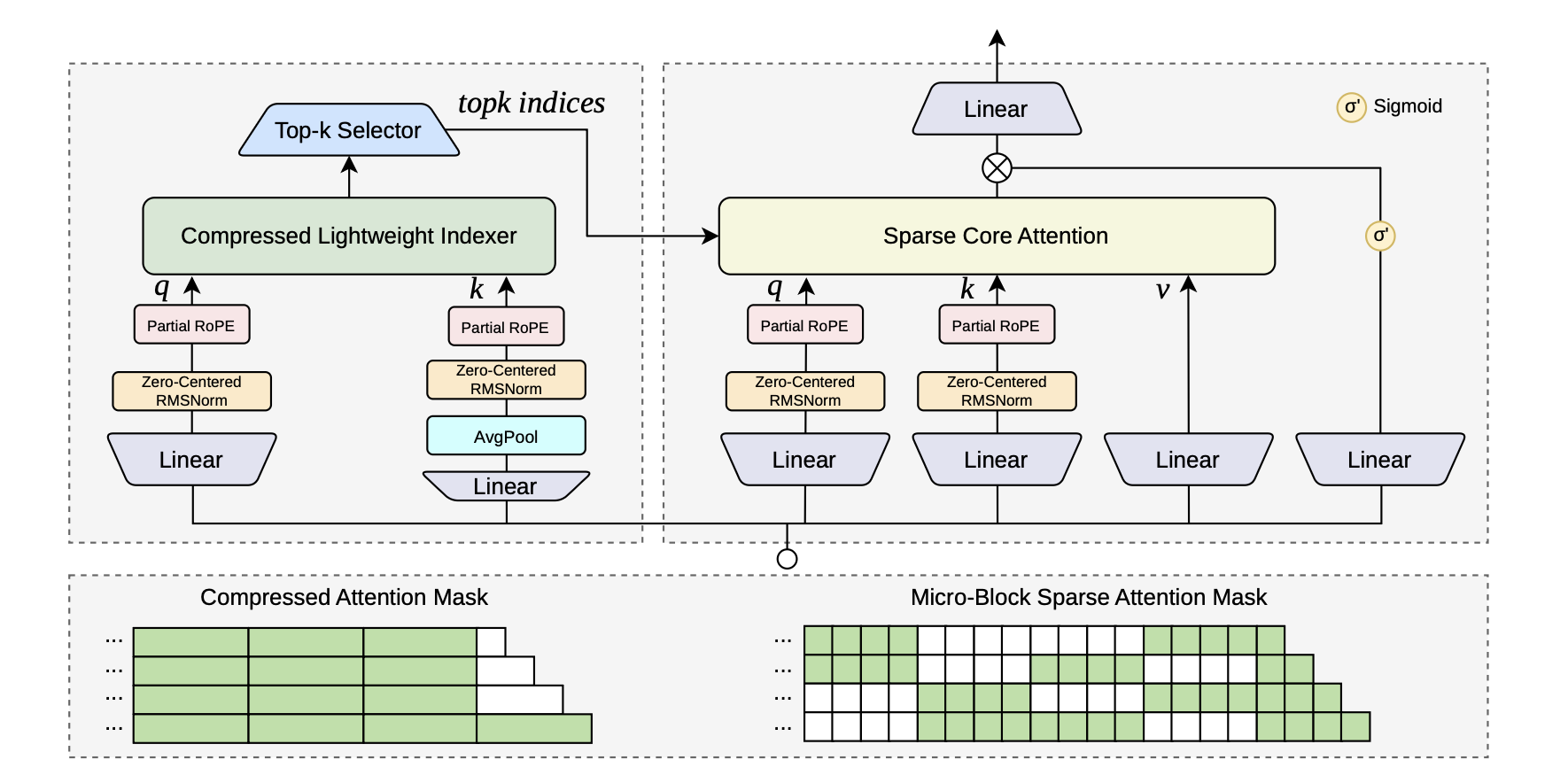
Qwen Sparse Attention (QSA)
The diagram above is the structural diagram of QSA. On the left side, the original token sequence is divided into chunks of, say, 16 or 64 tokens, and 'k' particularly important parts are selected. By expanding those specific parts back into the original token sequence, it becomes possible to increase computational efficiency without dropping accuracy. In the diagram on the bottom right showing the state of the tokens, the white sections are the sparse parts where no calculations are performed.
Summarizing GDN and QSA, it looks like the following. This attention mechanism might become a textbook example for AI development in the future.
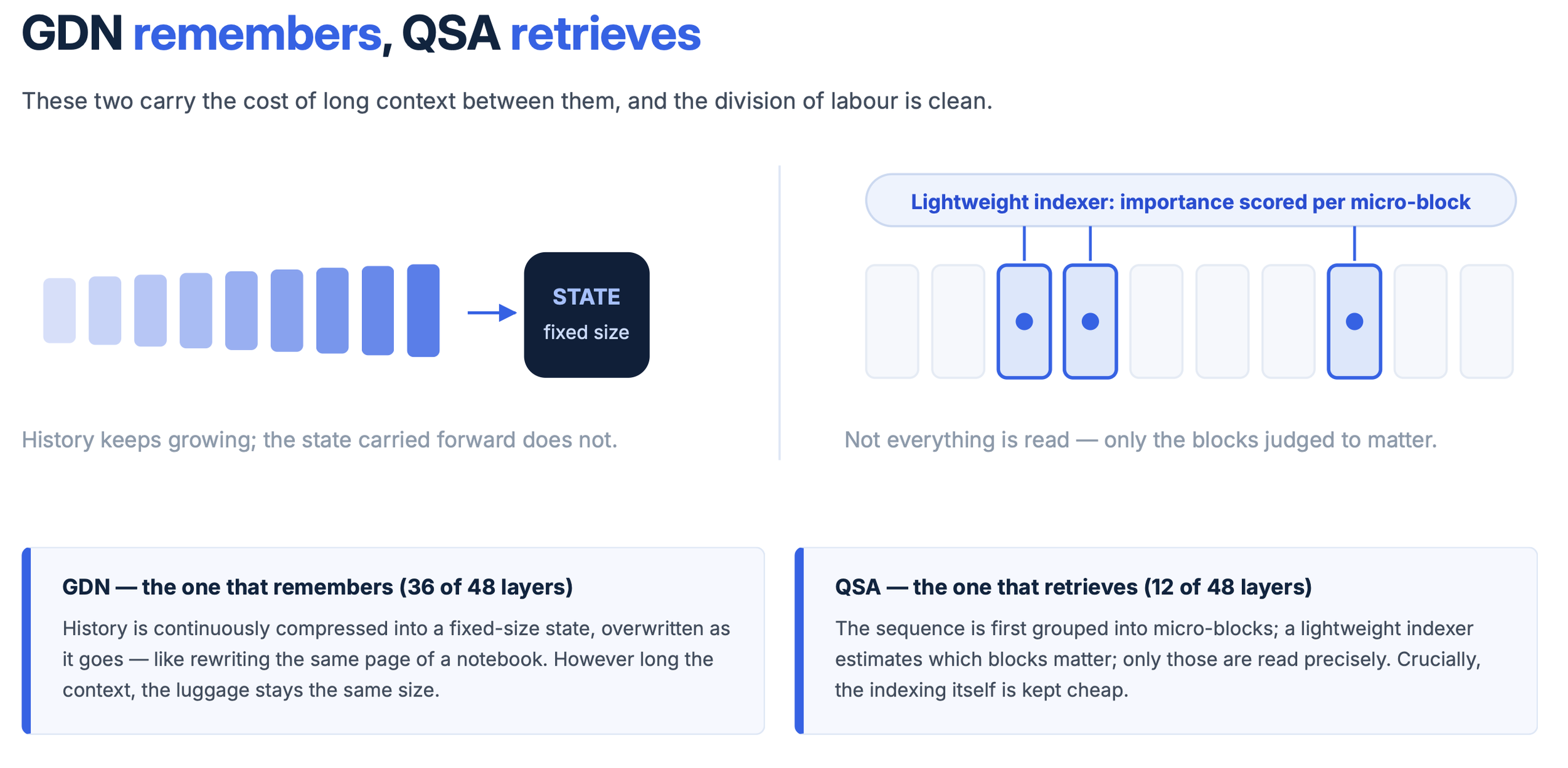
GDN and QSA
Additionally, the residual stream was expanded into a highly flexible one called "Gated Residual (GR)." Simply put, it means expanding the standard single flow of information into four, and further incorporating a mechanism that decides what information to read and where to write it. There is a mention of "GR Read/GR Write" in the overall structural diagram of Qwen3.8-Flash-Next above, and the read/write functions play an active role here. The residual stream became a de facto standard in the field of image recognition with a very famous 2015 paper called ResNet (2), but at the time, it was still a basic concept that simply added the original information to the information generated in each layer. This Gated Residual enables far more flexible information processing, and I was deeply moved to catch a glimpse of the technological progress made over this past decade.
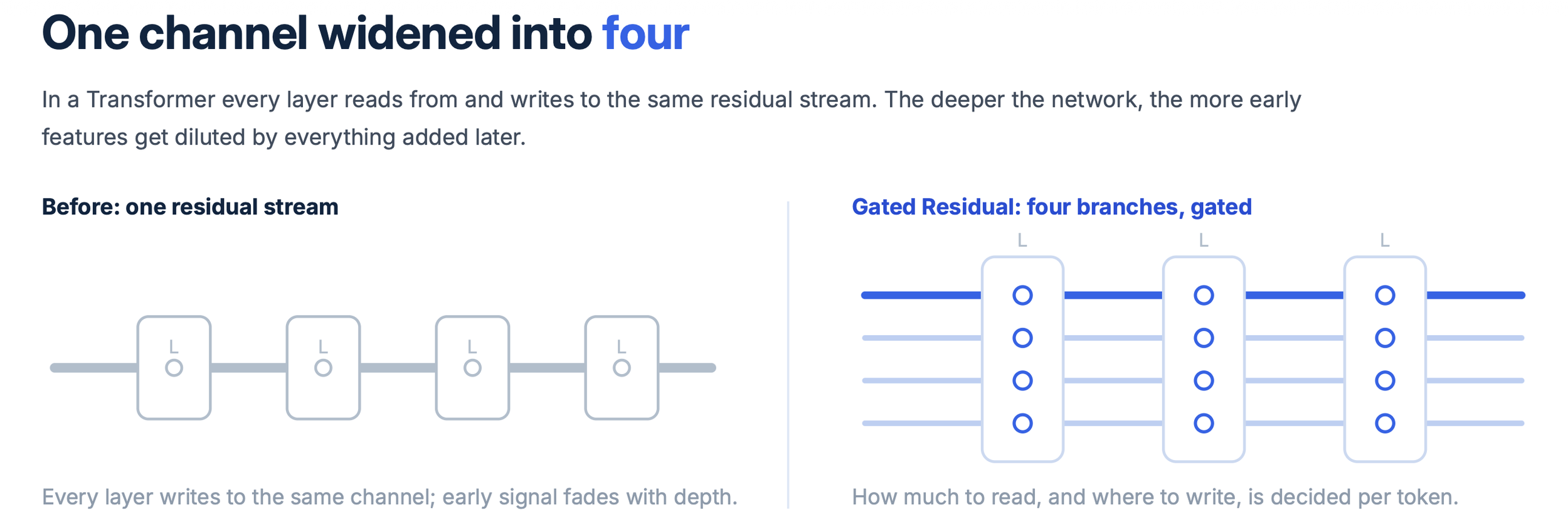
Gated Residual (GR)
Moreover, Qwen3.8-Flash-Next incorporates numerous other technologies, such as N-gram Embedding and the Muon optimization method. It seems that these ingenuities organically connect to give birth to a high-performance AI. I would like to share a sentence from the conclusion of their technical report:
The design reflects a conviction that architecture, efficiency, and optimization form one coupled system.
3. Performance of "Qwen3.8-Flash-Next"
Now, what about the actual performance of "Qwen3.8-Flash-Next", which has pursued efficiency to such an extent? A third-party evaluation is necessary, so let's look at the leaderboard below (3).
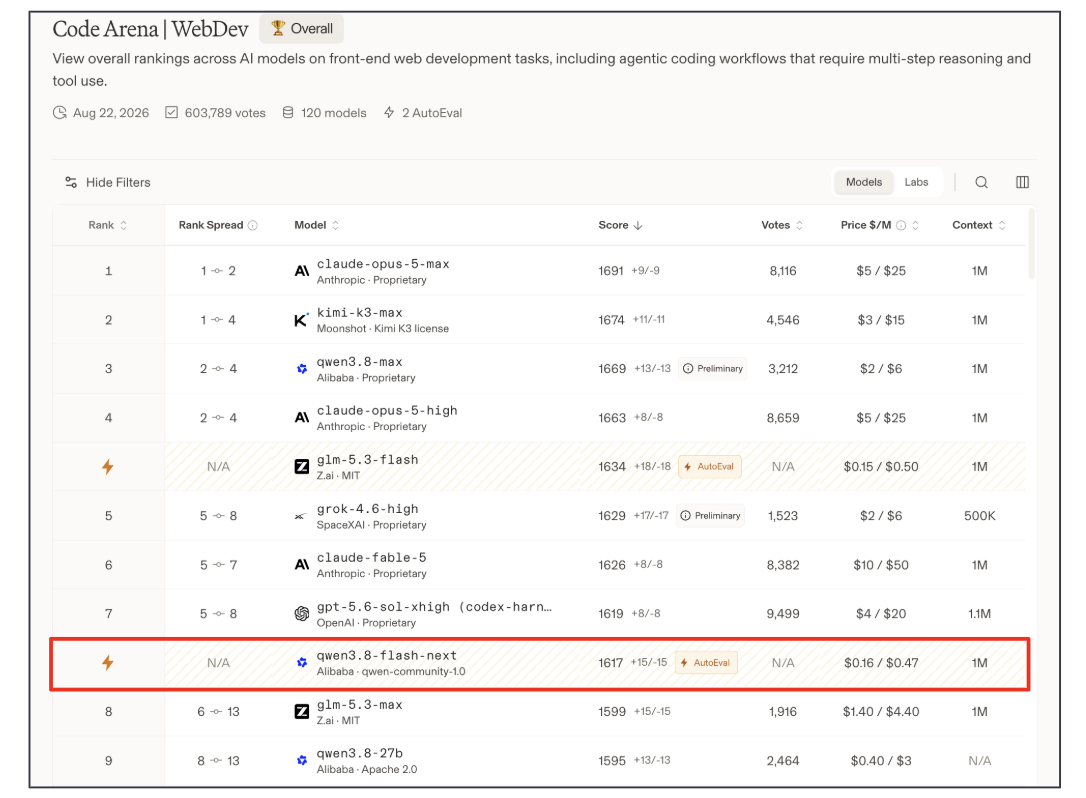
Arena
"Qwen3.8-Flash-Next" is positioned around 8th place, and naturally, it sits above Opus4.6. As expected, the performance of this model is incredible. The models ranked higher than it are all super-large frontier models, with parameter counts exceeding 1 trillion. "Qwen3.8-Flash-Next", which achieved the ability to break into the top ranks with only 125 billion parameters, can truly be called a magnificent AI. Also, since this AI is a preview version for evaluating "Qwen4," I am already incredibly excited to see what kind of performance the next-generation "Qwen4" will achieve.
What did you think? This was the first time I fully covered a Chinese-made AI. I felt it was fantastic because a detailed technical report was published, allowing for more concrete technological discussions. Classic technologies like attention mechanisms and residual connections are very meticulously combined, highlighting the high technical prowess of the development team. I believe researchers around the world engaging in AI development moving forward will undoubtedly reference this report, and it will likely further accelerate the development of AI worldwide. We really can't take our eyes off AI right now.
At Toshi Stats, we plan to continue challenging ourselves to explore the mechanisms of AI. Stay tuned!
You can enjoy our video news “ToshiStats AI Weekly Review” from this link, too!
1) Qwen3.8-Flash-Next: A New Architecture, Towards Ultimate Cost-Efficiency, 26 Aug 2026, Alibaba Cloud
2) Deep Residual Learning for Image Recognition, 10 Dec 2015, Kaiming He, Xiangyu Zhang, Shaoqing Ren, Jian Sun, Microsoft Research
3) Arena
Copyright © 2026 ToshiStats Co., Ltd. All right reserved.
Notice: This is for educational purpose only. ToshiStats Co., Ltd. and I do not accept any responsibility or liability for loss or damage occasioned to any person or property through using materials, instructions, methods, algorithms or ideas contained herein, or acting or refraining from acting as a result of such use. ToshiStats Co., Ltd. and I expressly disclaim all implied warranties, including merchantability or fitness for any particular purpose. There will be no duty on ToshiStats Co., Ltd. and me to correct any errors or defects in the report, the codes and the software.