

Hello everyone. Another exciting week with multiple new generative AI models launched!
Yet, there is an interesting observation: most generative AI models are trained primarily on text-based data, and their capabilities are predominantly benchmarked against text-centric tasks such as coding. In contrast, tabular data—which dominates day-to-day enterprise operations—has seen comparatively little discussion in this space. Recently, however, several startups have started releasing dedicated generative AI foundation models for tabular data as open-weight models. Today, we focus on a numerical regression task to explore the true potential of this paradigm.
1. Nori V1 and How It Works
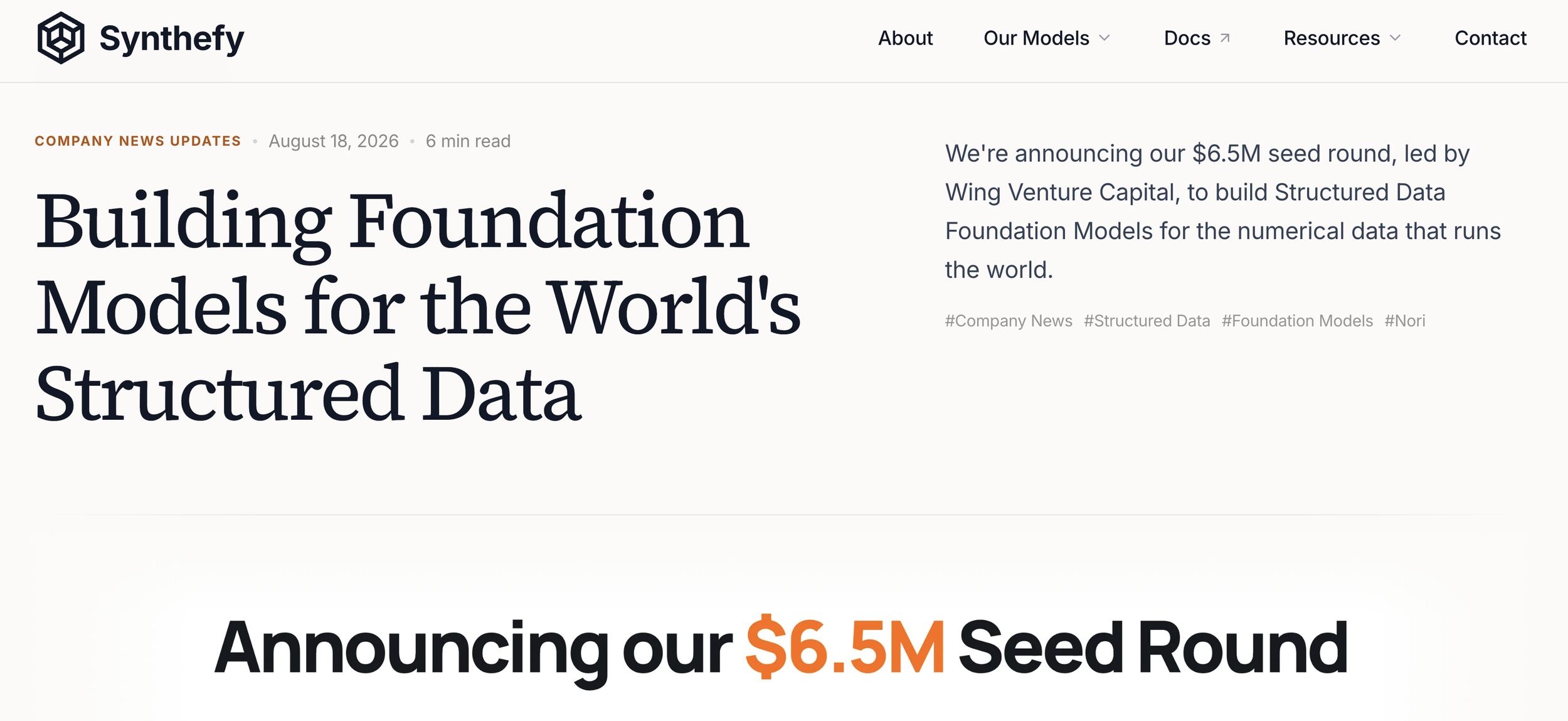
The foundation model highlighted today is Nori V1, developed by Synthefy. Synthefy is a high-momentum startup that recently closed a fresh funding round (1). Their website describes the release as follows:
"Nori V1 is the open-weight foundation model for tables. Apache 2.0 code and weights, free for commercial use."
The secret behind its high accuracy is In-Context Learning (ICL), a topic touched upon previously. In terms of data pipeline, context is constructed by assembling labeled training data and presenting it to the model upfront to set up the baseline for inference. Next, the test data intended for prediction is provided.
In practice, both the training and test sets are bundled into a single massive prompt fed directly into Nori V1 to run inference. In this benchmark, the objective is predicting house prices—a standard regression task.
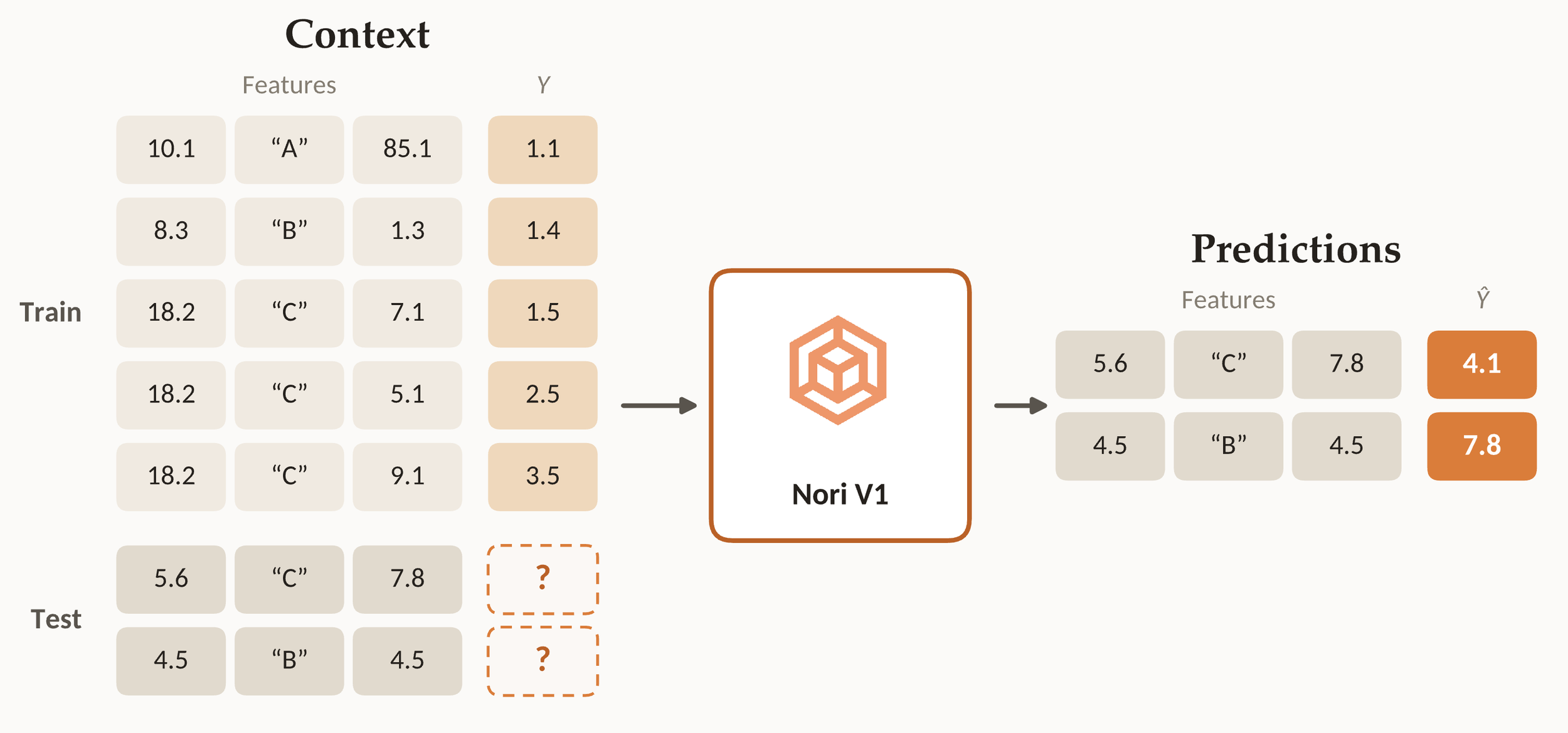
In-Context Learning (ICL)
The defining characteristic of ICL is that it operates entirely out-of-the-box with zero fine-tuning required. This makes it accessible even to non-specialists. But does it truly maintain competitive accuracy? Let’s test it against real-world data.
2. Benchmarking Nori V1 on Kaggle Data
Accuracy was validated using a Kaggle benchmark: With 79 explanatory variables describing (almost) every aspect of residential homes in Ames, Iowa, this competition challenges you to predict the final price of each home. (2).
An overview of the dataset is provided below. With only 1,460 samples, this is hardly sufficient for training a machine learning prediction model. Let's see what level of accuracy can be achieved with a sample size like this.

Overview of the Competition Data
I evaluated the model's accuracy ceiling using 1,000 training samples and submitted the predictions to the Kaggle leaderboard. At the time of submission, the result placed 43rd out of 3,138 entries—within the top 1.4%—an outstanding outcome. Because no training was required, the process simply involved feeding the "1,000 reference samples + test data" into the model and submitting the output. It achieved the ideal balance: remarkable simplicity paired with high predictive accuracy.
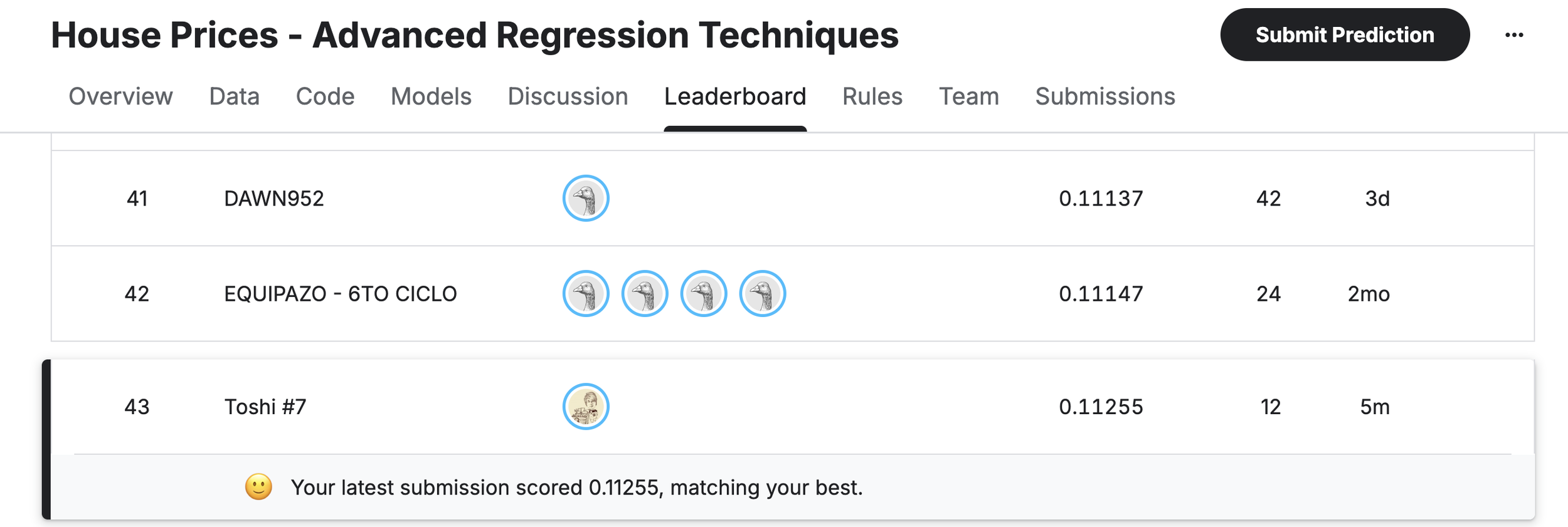
The result placed 43rd out of 3,138 entries—within the top 1.4%.
With a modest total of 1,460 samples, conventional gradient boosting libraries like LightGBM often face constraints from data scarcity. In these low-sample regimes, Nori V1 proved remarkably effective.
3. Use Case: Tackling the Cold-Start Problem
If foundation models can deliver high predictive accuracy on scarce tabular data, the most immediate application is resolving the cold-start problem. In client consulting engagements, a frequent blocker is: "We are still accumulating data, so predictive modeling is off the table until our database grows."
With an ICL foundation model like Nori V1, teams can begin running predictions immediately on whatever preliminary data is available, driving earlier data-backed operational decisions across initiatives such as:
Launching new products or services
Entering new regional markets
Targeting uncharted customer segments
Where decision-makers previously had to rely on intuition due to limited baseline records, ICL tabular models provide a grounded foundation for rational decision-making from day one.
To wrap up, a quote from Synthefy captures the broader ambition:
"We are building Machine Intelligence for the class of decisions humans could never make at all."
At ToshiStats, we will continue pushing the boundaries of In-Context Learning (ICL) across tabular data science. Stay tuned!
You can enjoy our video news “ToshiStats AI Weekly Review” from this link, too!
1) Building Foundation Models for the World's Structured Data, August 18 2026, Synthefy
2) House Prices - Advanced Regression Techniques, kaggle
Copyright © 2026 ToshiStats Co., Ltd. All right reserved.
Notice: This is for educational purpose only. ToshiStats Co., Ltd. and I do not accept any responsibility or liability for loss or damage occasioned to any person or property through using materials, instructions, methods, algorithms or ideas contained herein, or acting or refraining from acting as a result of such use. ToshiStats Co., Ltd. and I expressly disclaim all implied warranties, including merchantability or fitness for any particular purpose. There will be no duty on ToshiStats Co., Ltd. and me to correct any errors or defects in the report, the codes and the software.