
On October 9, 2026, a new decision AI model was released by Microsoft (1). It is named "Microsoft-Decision-1." In this article, I would like to test its performance by comparing it with several other decision AI models, including its predecessor, Jev (2). Let's get started right away.
1. What is "Microsoft-Decision-1"?
The AI models we have become familiar with through chat interfaces are called Large Language Models (LLMs). In exchange for their remarkable reasoning capabilities, they suffer from slow output speeds and high operational costs—a major headache for users. This has become a significant barrier hindering "workflow automation," which requires processing massive amounts of information in corporate environments. Consequently, decision AI models enabling rapid output and low-cost operation have been developed, and new models are now being released one after another. Microsoft has also entered this market by announcing its new decision AI model, "Microsoft-Decision-1." According to Microsoft's website, this model has the following characteristics:
“This model is designed for routing, classification, prioritization, verification, and workflow control, making it easier to incorporate decision intelligence into existing applications, agents, and workflows in a secure, trusted environment.“
It looks promising, with potential applications across various fields and flexible operation. Let's give it a try right away.
2. Comparison and Verification with Several Decision AI Models
Once again, we will extract 200 samples of bank customer complaints (3) and consider the task of determining which financial product each complaint corresponds to. Since there are five financial products, we will be solving a five-class classification task. The prompt used in this experiment is shown below.
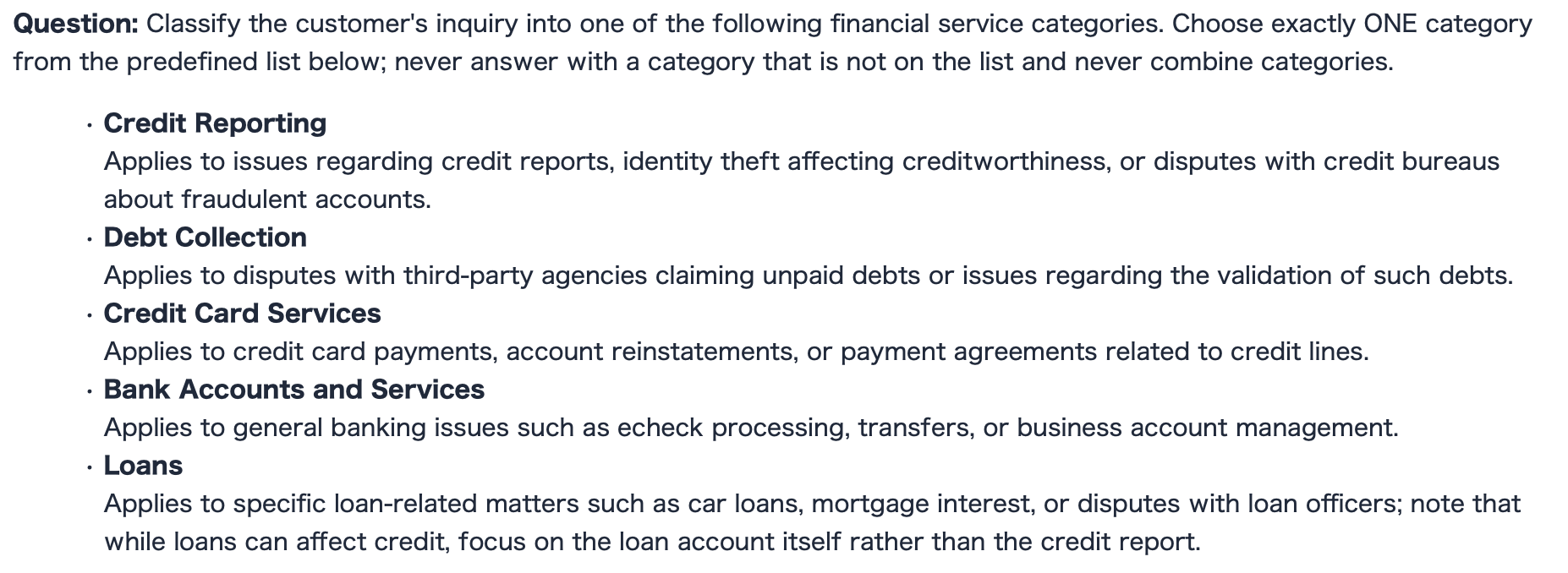
Prompt used in the experiment
A total of six decision AI models will compete in performance, including its predecessor Jev and open-weight models. To use a common infrastructure for the execution environment, I adopted OpenRouter. All models except the Tev1:4B model were run in the exact same environment. Tev1:4B was run on my MacBook Air M4 24GB. First, let's compare accuracy and processing speed.
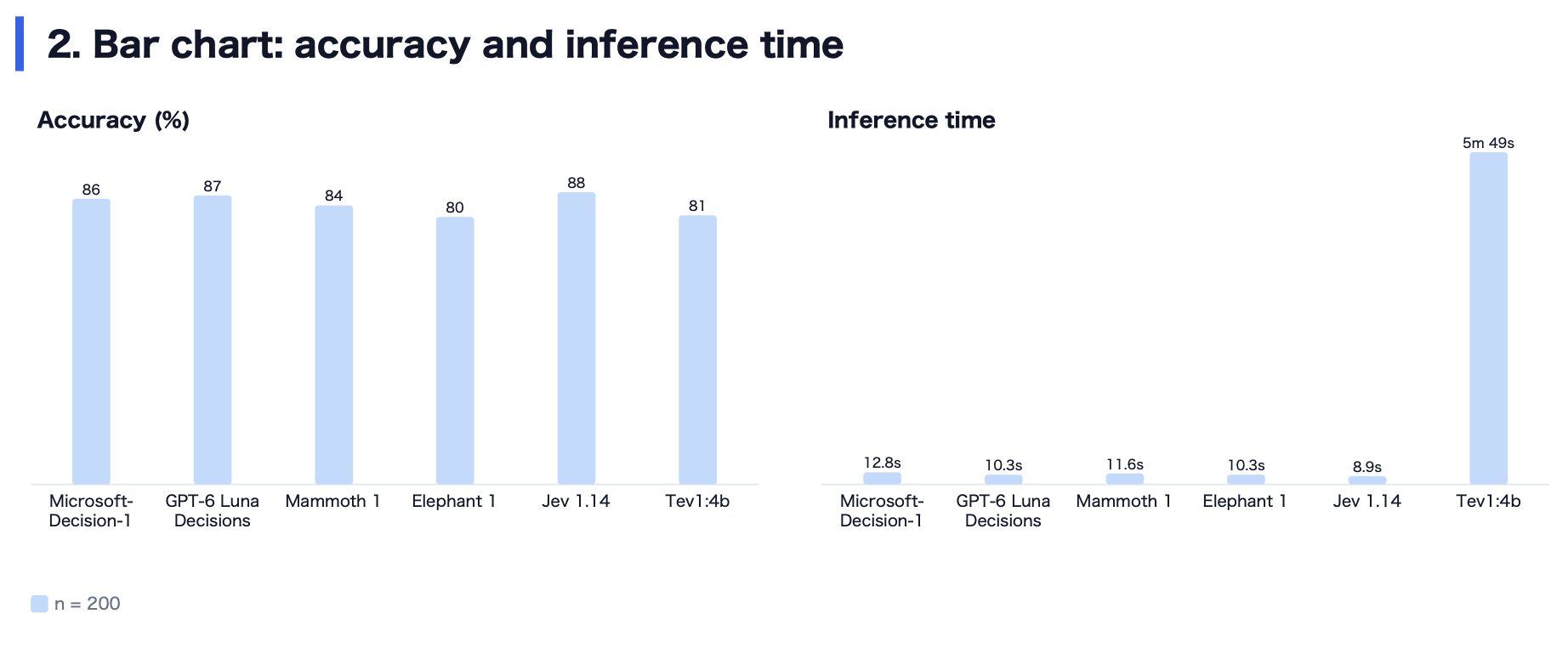
Microsoft-Decision-1 achieved an accuracy of 86%, ranking third in performance. On the other hand, its processing speed was 12.8 seconds, placing it fifth out of the six models. For this sample set, while the accuracy was very high, I felt the computation speed was not quite as fast as expected.
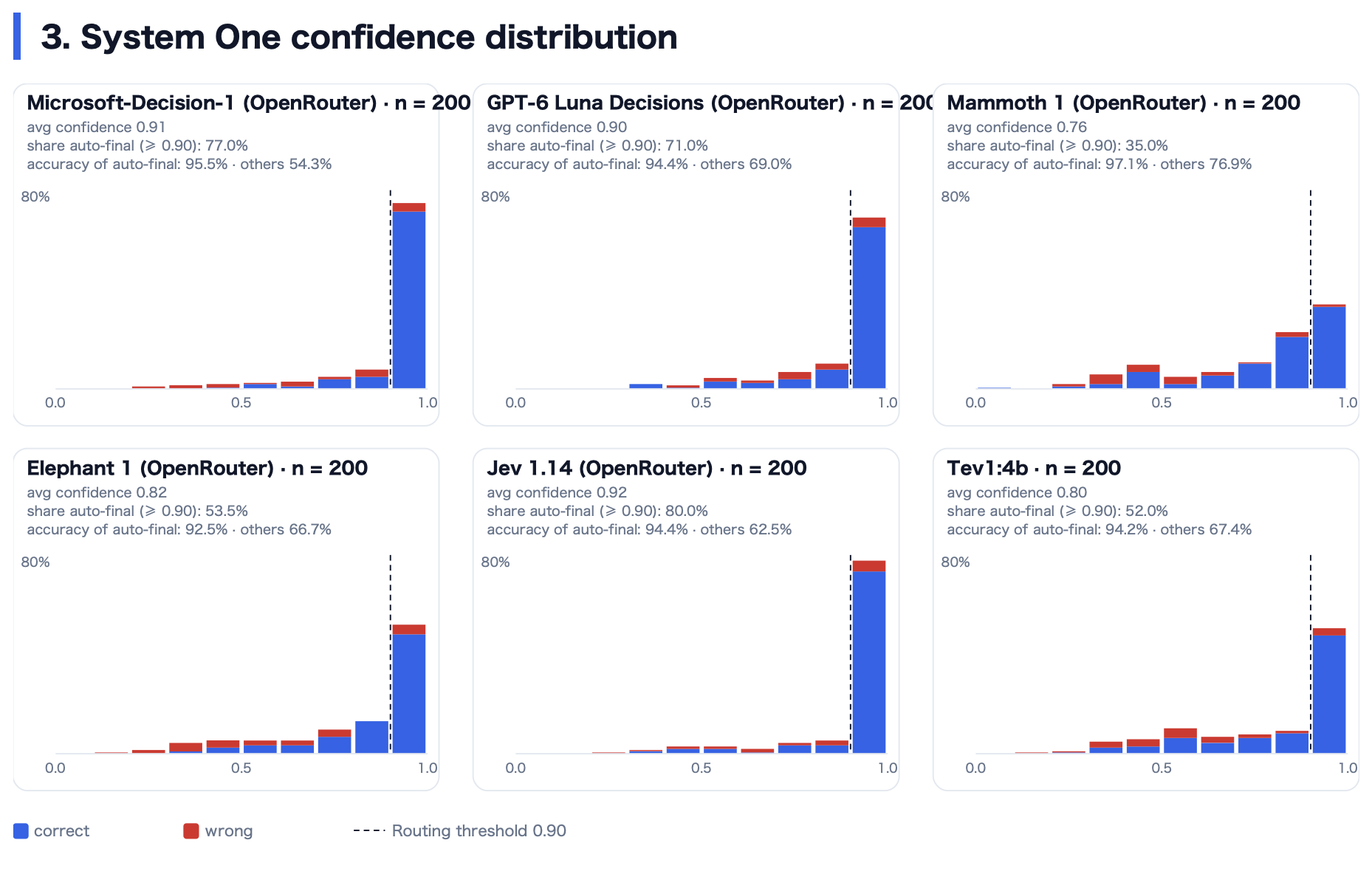
In decision AI models, "confidence"—which indicates the model's degree of certainty regarding each output—plays a crucial role. The chart above shows the distribution of that confidence. Microsoft-Decision-1 covers 77% of the total samples at a confidence level of 90% or higher, ranking second only to Jev. Furthermore, the accuracy within that 77% subset of samples was exceptionally high at 95.5%. This result rivals that of its predecessor Jev, and is an impressive outcome that raises expectations for applications across a wide variety of fields. Detailed analysis results are provided below.
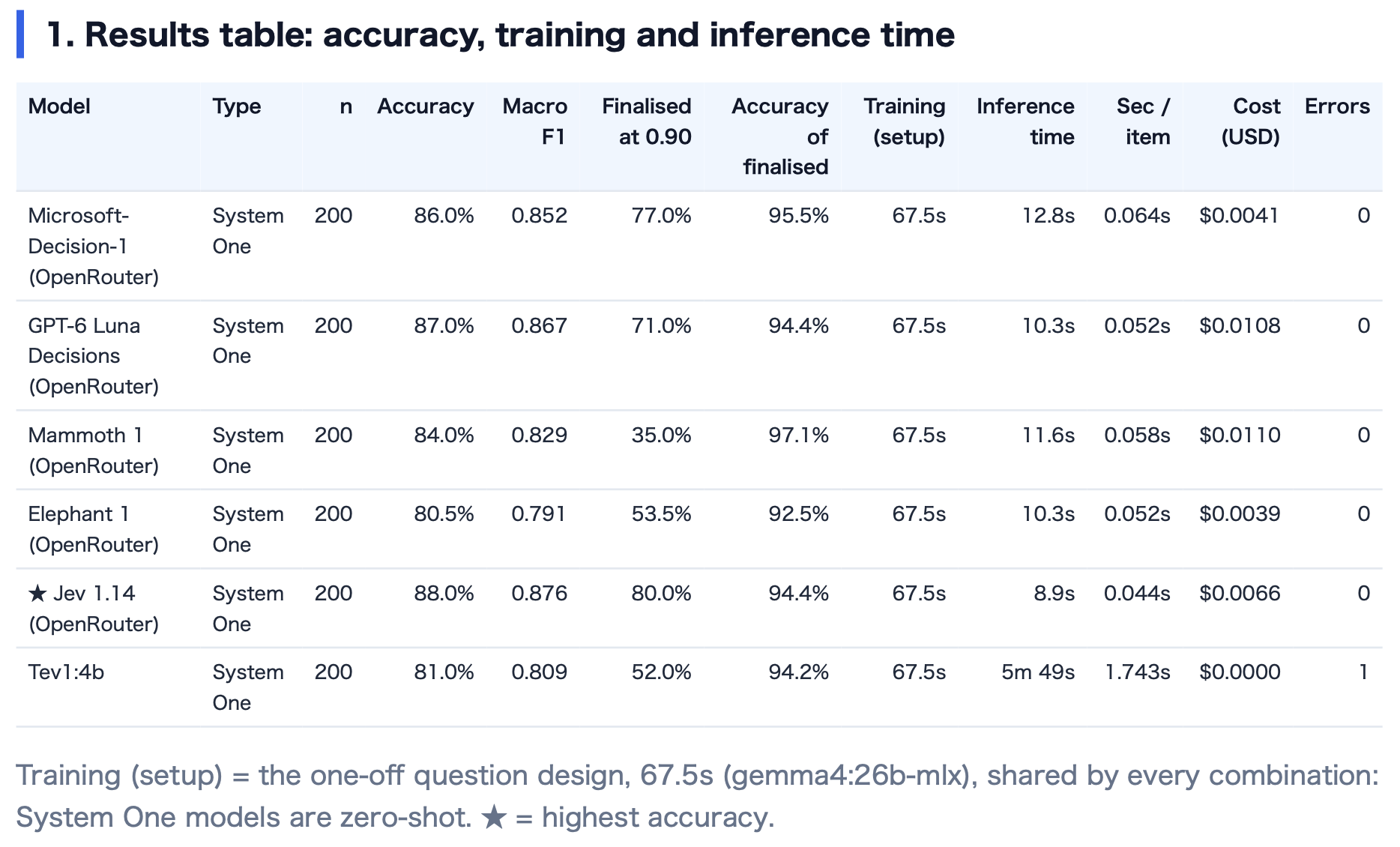
Incidentally, the cost incurred for the Microsoft-Decision-1 experiment was $0.0041 USD, ranking second among the paid models, which makes it a highly cost-effective model. Fantastic.
3. Applying Microsoft-Decision-1 to Business Automation
As shown, Microsoft-Decision-1 offers good accuracy, low computational cost, and sufficient processing speed. In particular, its ability to filter correct answers based on "confidence" is exceptionally high, meaning there are likely many cases where it can be applied even in environments where errors cannot be tolerated. While various use cases are conceivable, it might be best to start with basic classification tasks. For multi-class classification like the one in this experiment, even in zero-shot operation without specific model training, high accuracy can be achieved by making effective use of "confidence." Possible use cases include the examples listed below:
Incident Response Triage: Classifying incidents by type and urgency to determine their response priority.
Intent Analysis: Identifying a customer's intent from a pre-prepared set of candidates based on user communications such as emails or phone calls, in order to provide the optimal service that enhances customer satisfaction.
Approval Document (Ringisho) Review: Verifying whether a draft approval document meets the requirements stipulated in company regulations and assessing the completeness of the draft.
Next-Best-Action Recommendation: Selecting and recommending the most appropriate products, services, offers, or actions from a pre-prepared set of options.
These are merely examples, and Microsoft-Decision-1 is expected to be utilized in a wide variety of scenarios. If operated effectively, we can expect significant progress in workflow-automation.
What did you think? The development of decision AI models has only just begun. As high-performance models are expected to emerge one after another in the future, we at ToshiStats plan to actively adopt decision AI models like Microsoft-Decision-1 and take on the challenge of workflow automation. Stay tuned.
1) Introducing Microsoft-Decision-1, our model for fast decision-making, Oct 9 2026, Microsoft
2) Introducing System One Models & Jev, Sep 15 2026, Diogo Almeida, founder, TypeSafe
3) Consumer Financial Protection Bureau
Copyright © 2026 ToshiStats Co., Ltd. All right reserved.
Notice: This is for educational purpose only. ToshiStats Co., Ltd. and I do not accept any responsibility or liability for loss or damage occasioned to any person or property through using materials, instructions, methods, algorithms or ideas contained herein, or acting or refraining from acting as a result of such use. ToshiStats Co., Ltd. and I expressly disclaim all implied warranties, including merchantability or fitness for any particular purpose. There will be no duty on ToshiStats Co., Ltd. and me to correct any errors or defects in the report, the codes and the software.