
2025 was the year the coding style known as "Vibe Coding" truly gained mainstream acceptance. So, for this post, I conducted an experiment to see just how far we could go in building a machine learning model using only AI agents via "Vibe Coding"—with almost zero human programming involved. Let's get started!
The Importance of the "Product Requirement Document" for Task Description
This time, I wanted to build a model that predicts whether bank loan customers will default. I used the publicly available Credit Card Default dataset (1).
In Vibe Coding, we delegate the actual writing of the program to the AI agent, while the human shifts to a reviewer role. In practice, having a tool called a "Code Assistant" is very convenient. For this experiment, I used Google's Gemini CLI. For the IDE, I used the familiar VS Code.
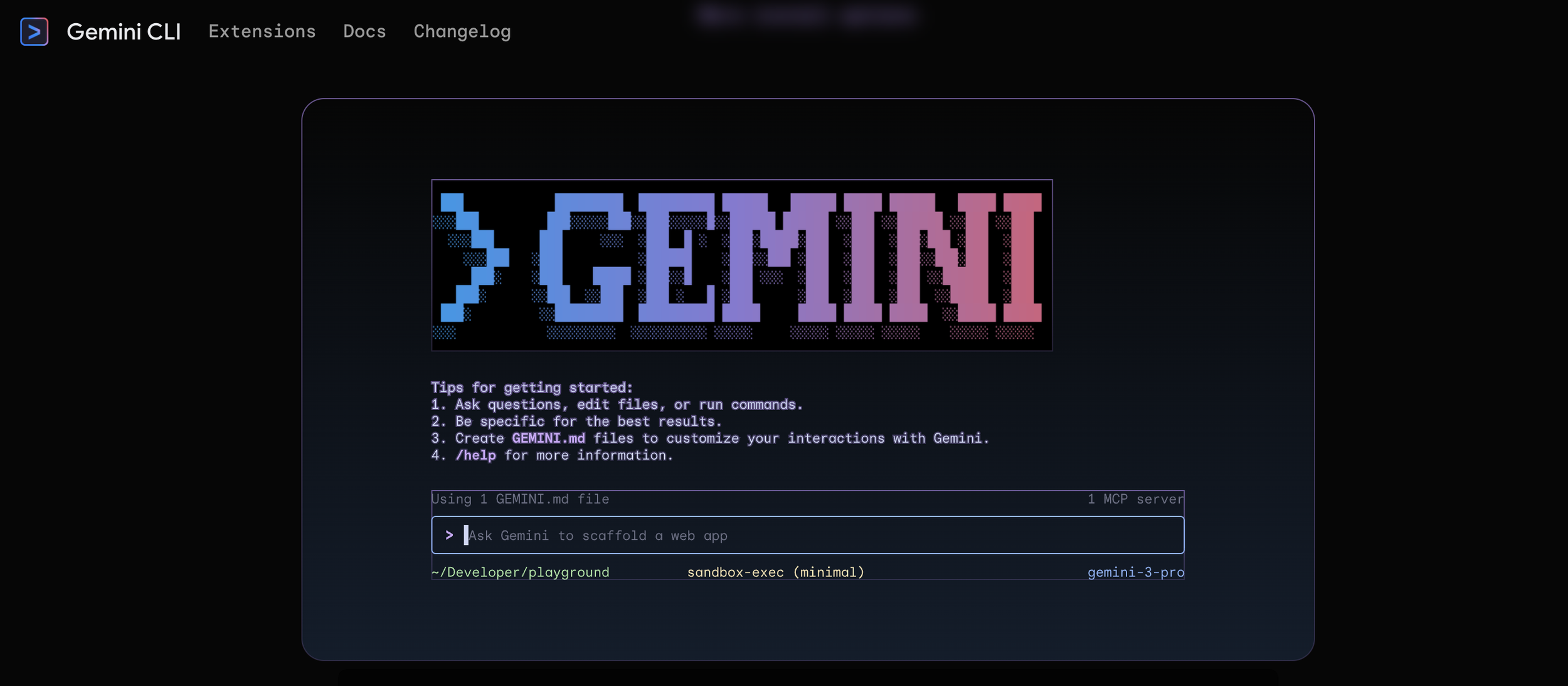
Gemini CLI
To entrust the coding to an AI agent, you must teach it exactly what you want it to do. While it is common to enter instructions as prompts in a chatbot, in Vibe Coding, we want to use the same prompts repeatedly, so we often input them as Markdown files.
It is best to use what is called a "Product Requirement Document (PRD)" for this content. You summarize the goals you want the product to achieve, the libraries you want to use, etc. The PRD I created this time is as follows:

PRD
By referencing this PRD and entering a prompt to create a default prediction model, the model was built in just a few minutes. The evaluation metric, AUC, was also excellent, ranging between 0.74 and 0.75. Amazing!!
2. Describing the Folder Structure with PROJECT_SUMMARY
It is wonderful that the machine learning model was created, but if left as is, we won't know which files are where, and handing it over to a third party becomes difficult.
Therefore, if you input the prompt: "Analyze the current directory structure and create a concise summary that includes: 1. A tree view of all files 2. Brief description of what each file does 3. Key dependencies and their purposes 4. Overall architecture pattern Save this as PROJECT_SUMMARY.md", it will create a Markdown file like the one below for you.
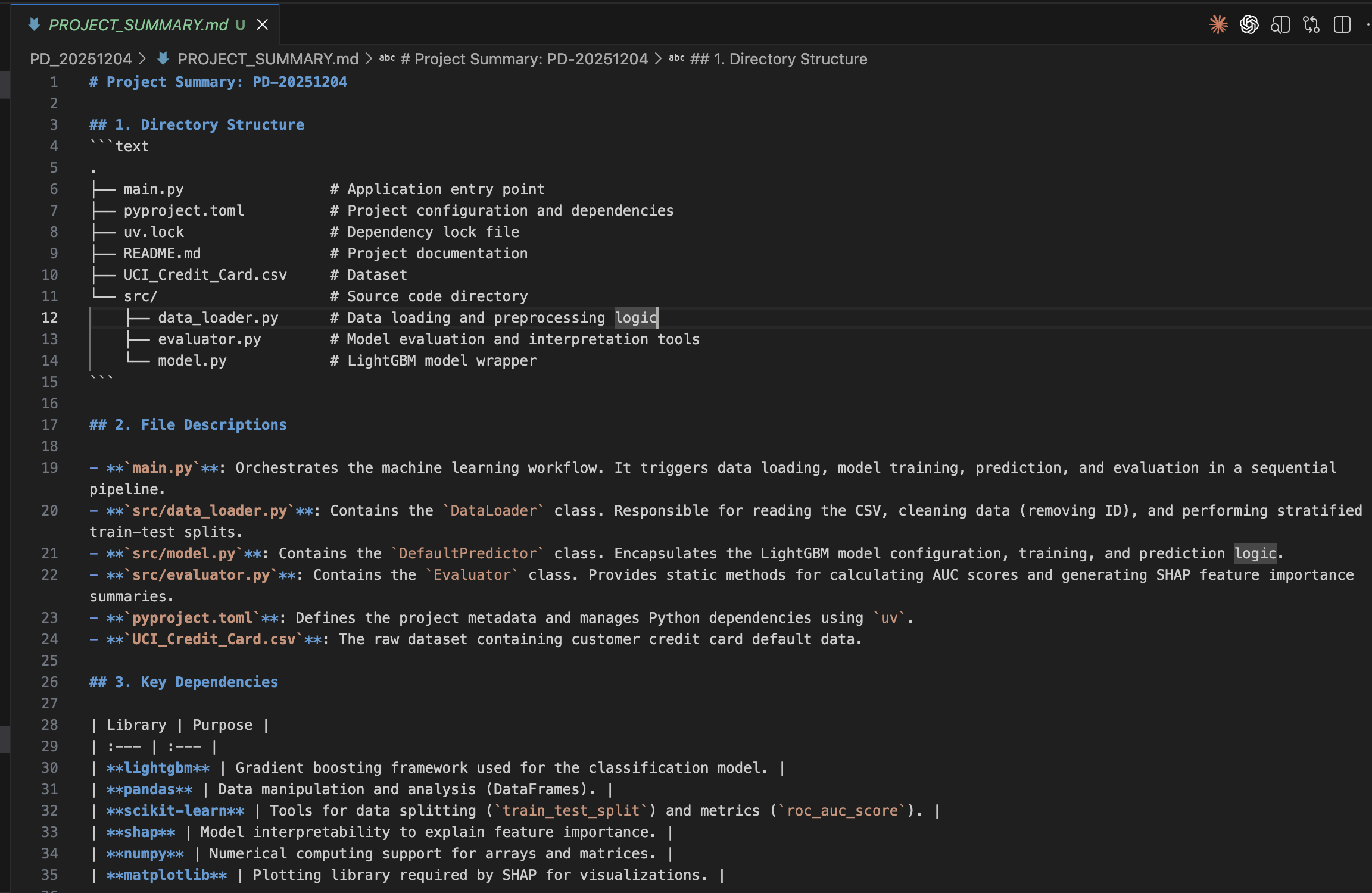
PROJECT_SUMMARY.md
With this, anyone can understand the folder structure at any time, and it is also convenient when adding further functional extensions later. I highly recommend creating a PROJECT_SUMMARY.md.
3. Adding a UI and Turning the ML Model into an App
Since we built such a good model, we want people to use it. So, I experimented to see if I could build an app using Vibe Coding as well.
I created PRD-pdapp.md and asked the AI agent to build the app. I instructed it to save the model file and to use Streamlit for app development. The actual file and its translation are below:
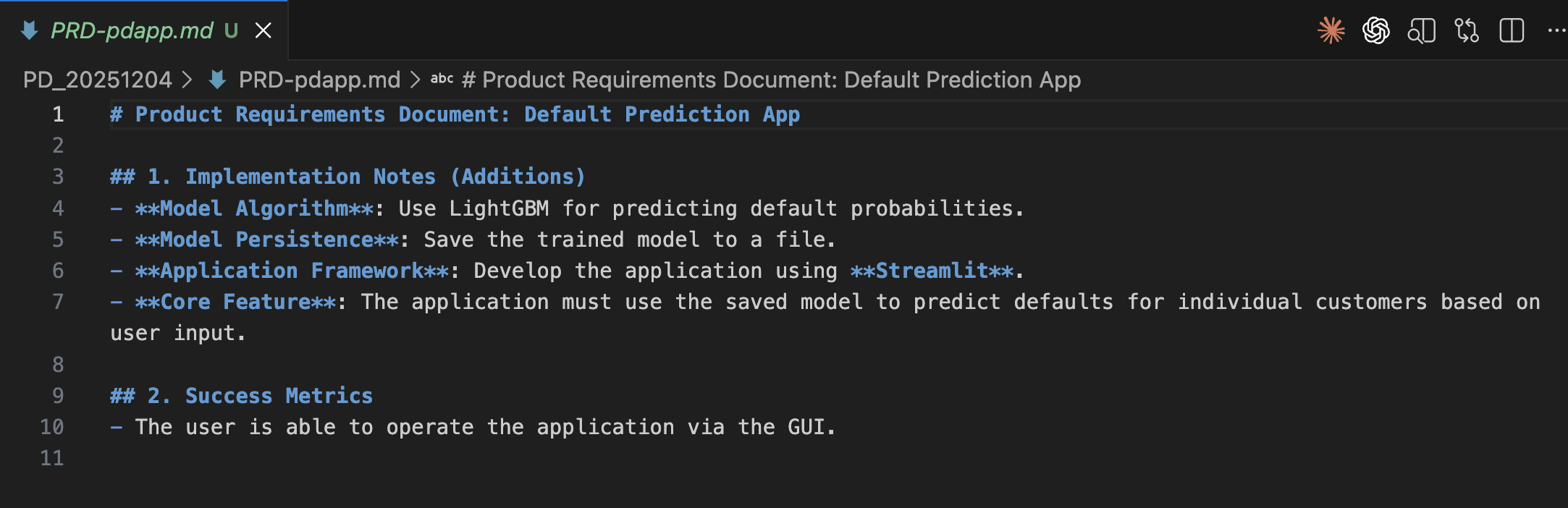
PRD-pdapp.md
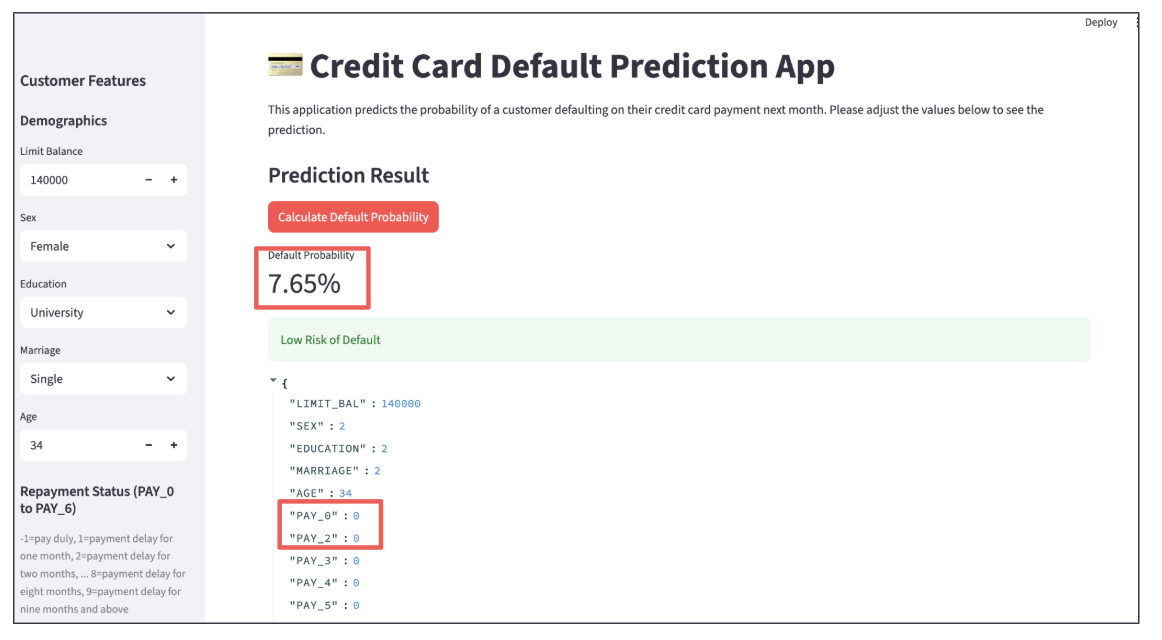
When executed, the following app was created. It looks cool, doesn't it?
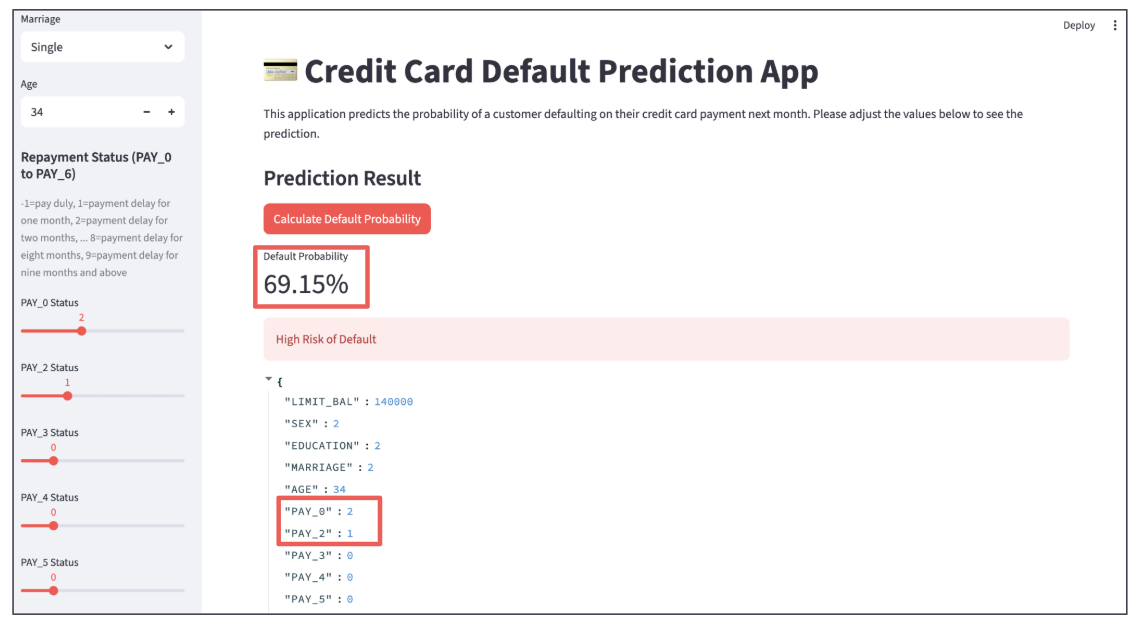
You can input customer data using the boxes and sliders on the left, and when you click the red button, the probability of default is calculated.
Customer 1: Default probability is 7.65%, making them a low-risk customer.
Customer 2: Default probability is 69.15%, which is high, so I don't think we can offer them a loan. The
PAY_0 Statusis "2", meaning their most recent payment status is 2 months overdue. This is the biggest factor driving up the default probability.
As you can see, having a UI is incredibly convenient because you can check the model's behavior by changing the input data. I was able to create an app like this using Vibe Coding. Wonderful.
How was it? It was indeed possible to perform machine learning using Vibe Coding. However, instead of programming code, you need to create precise PRDs. I believe this will become a new and crucial skill. I encourage you all to give it a try.
That’s all for today. Stay tuned!
You can enjoy our video news ToshiStats-AI from this link, too!
Copyright © 2025 Toshifumi Kuga. All right reserved
Notice: ToshiStats Co., Ltd. and I do not accept any responsibility or liability for loss or damage occasioned to any person or property through using materials, instructions, methods, algorithms or ideas contained herein, or acting or refraining from acting as a result of such use. ToshiStats Co., Ltd. and I expressly disclaim all implied warranties, including merchantability or fitness for any particular purpose. There will be no duty on ToshiStats Co., Ltd. and me to correct any errors or defects in the codes and the software.