
Gemini 3

Can You "Vibe Code" Machine Learning? I Tried It and Built an App

2025 was the year the coding style known as "Vibe Coding" truly gained mainstream acceptance. So, for this post, I conducted an experiment to see just how far we could go in building a machine learning model using only AI agents via "Vibe Coding"—with almost zero human programming involved. Let's get started!

 
  1. The Importance of the "Product Requirement Document" for Task Description

This time, I wanted to build a model that predicts whether bank loan customers will default. I used the publicly available Credit Card Default dataset (1).

In Vibe Coding, we delegate the actual writing of the program to the AI agent, while the human shifts to a reviewer role. In practice, having a tool called a "Code Assistant" is very convenient. For this experiment, I used Google's Gemini CLI. For the IDE, I used the familiar VS Code.
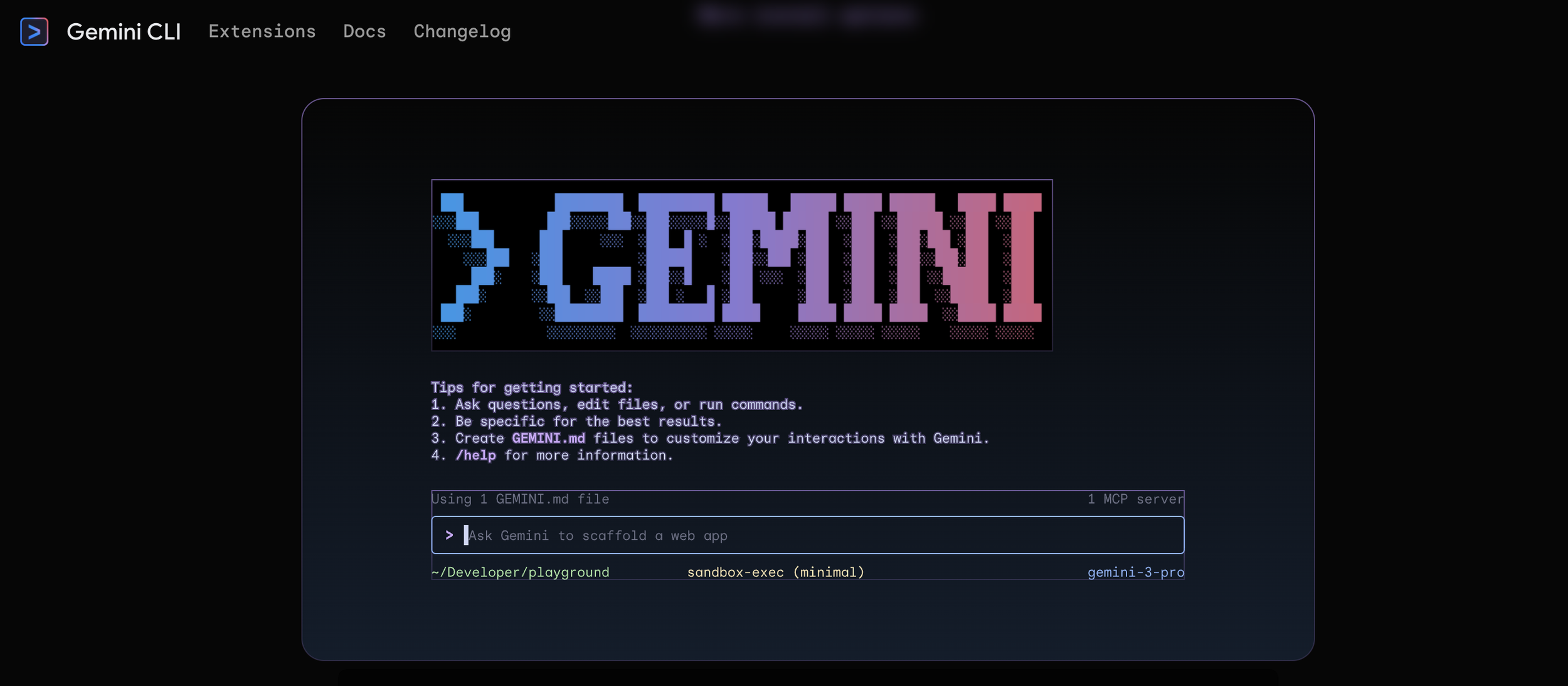
Gemini CLI

To entrust the coding to an AI agent, you must teach it exactly what you want it to do. While it is common to enter instructions as prompts in a chatbot, in Vibe Coding, we want to use the same prompts repeatedly, so we often input them as Markdown files.

It is best to use what is called a "Product Requirement Document (PRD)" for this content. You summarize the goals you want the product to achieve, the libraries you want to use, etc. The PRD I created this time is as follows:

PRD

By referencing this PRD and entering a prompt to create a default prediction model, the model was built in just a few minutes. The evaluation metric, AUC, was also excellent, ranging between 0.74 and 0.75. Amazing!!


2. Describing the Folder Structure with PROJECT_SUMMARY

It is wonderful that the machine learning model was created, but if left as is, we won't know which files are where, and handing it over to a third party becomes difficult.

Therefore, if you input the prompt: "Analyze the current directory structure and create a concise summary that includes: 1. A tree view of all files 2. Brief description of what each file does 3. Key dependencies and their purposes 4. Overall architecture pattern Save this as PROJECT_SUMMARY.md", it will create a Markdown file like the one below for you.
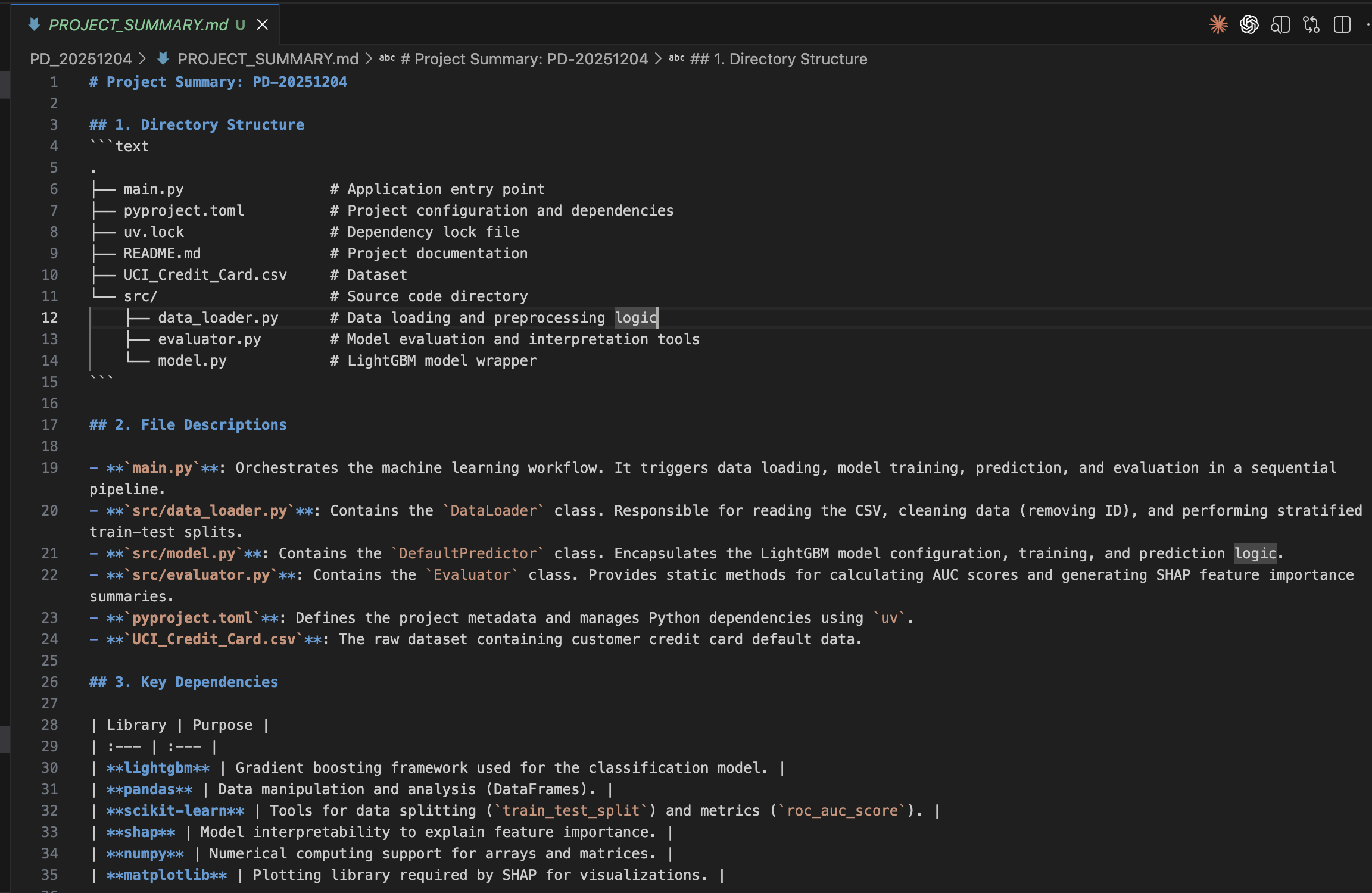
PROJECT_SUMMARY.md

With this, anyone can understand the folder structure at any time, and it is also convenient when adding further functional extensions later. I highly recommend creating a PROJECT_SUMMARY.md.


3. Adding a UI and Turning the ML Model into an App

Since we built such a good model, we want people to use it. So, I experimented to see if I could build an app using Vibe Coding as well.

I created PRD-pdapp.md and asked the AI agent to build the app. I instructed it to save the model file and to use Streamlit for app development. The actual file and its translation are below:
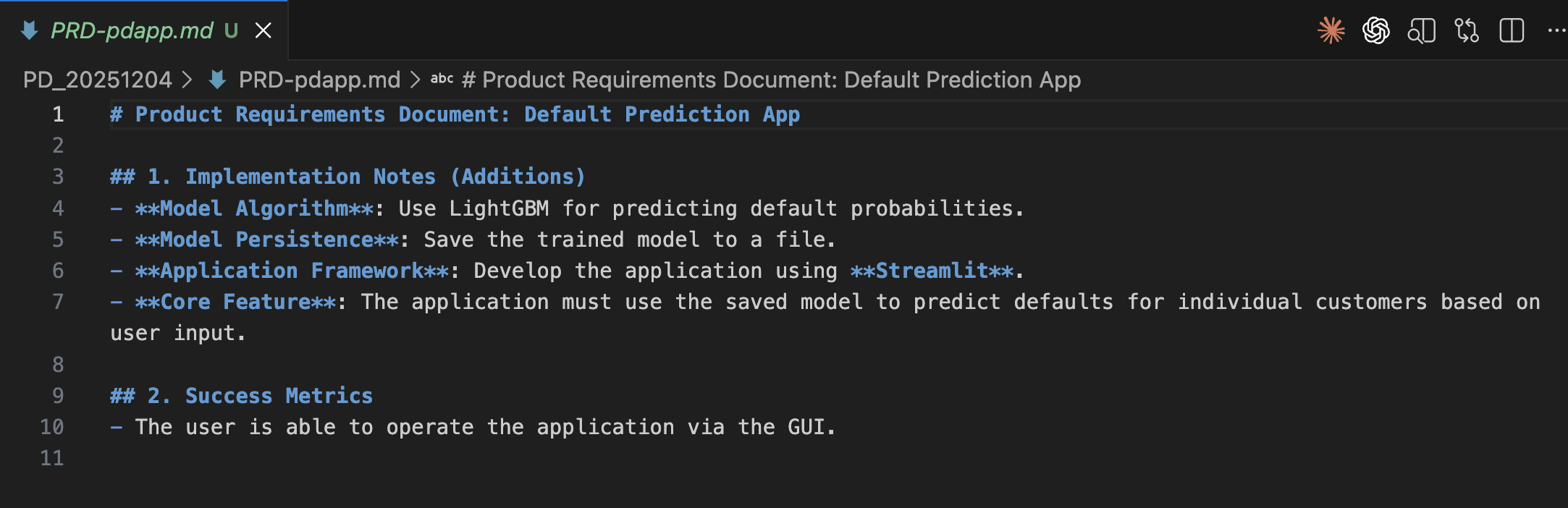
PRD-pdapp.md

When executed, the following app was created. It looks cool, doesn't it?

You can input customer data using the boxes and sliders on the left, and when you click the red button, the probability of default is calculated.

  • Customer 1: Default probability is 7.65%, making them a low-risk customer.

  • Customer 2: Default probability is 69.15%, which is high, so I don't think we can offer them a loan. The PAY_0 Status is "2", meaning their most recent payment status is 2 months overdue. This is the biggest factor driving up the default probability.
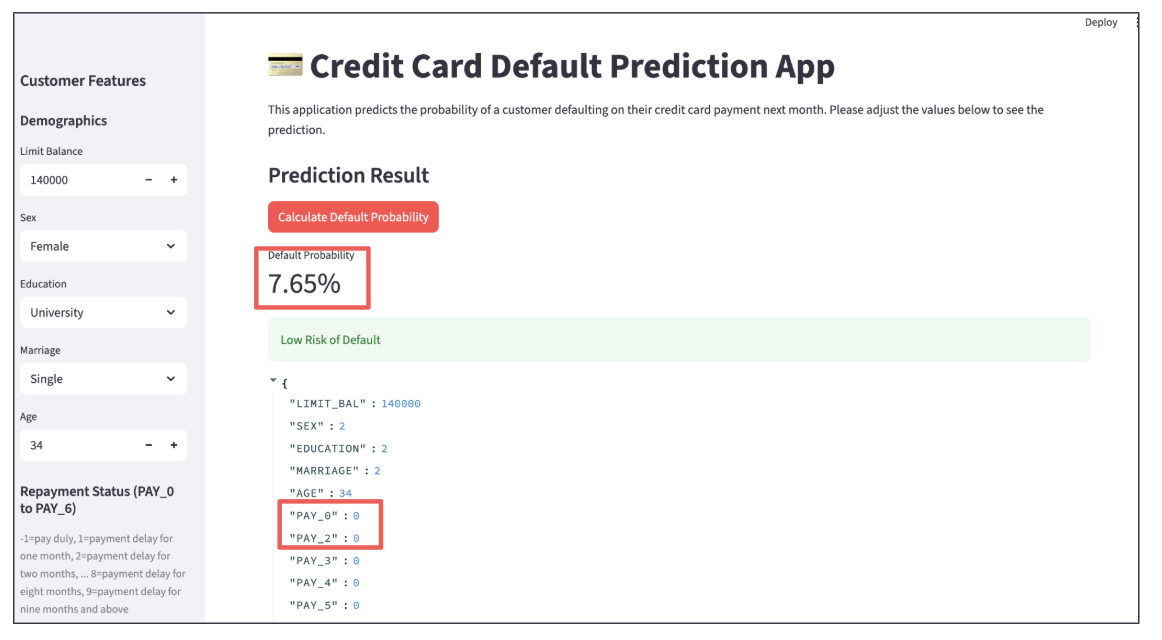
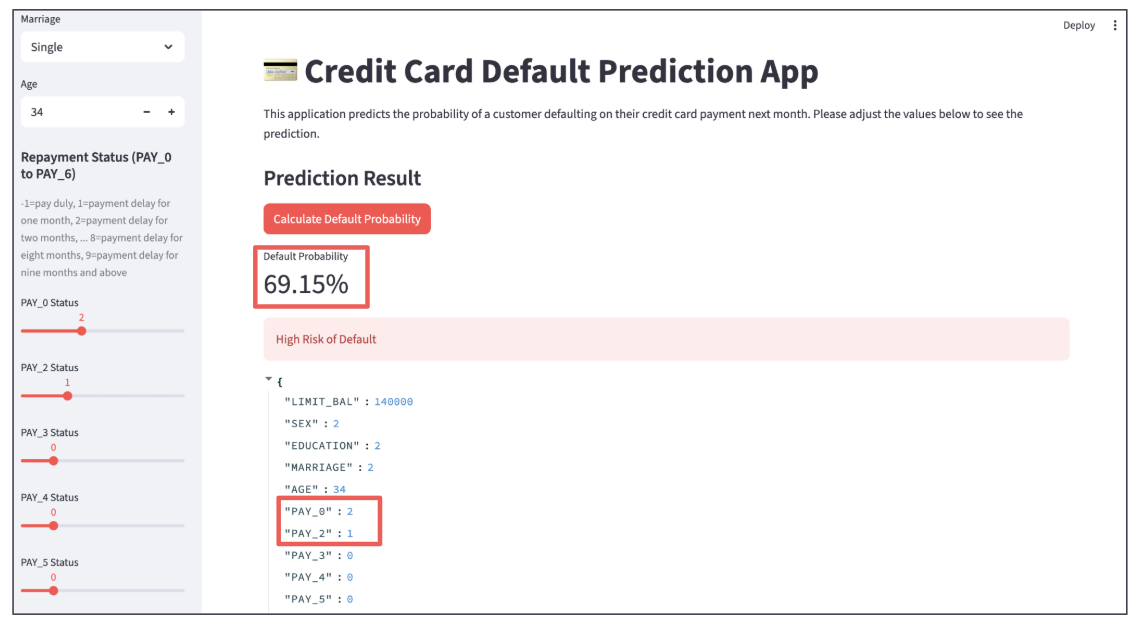
As you can see, having a UI is incredibly convenient because you can check the model's behavior by changing the input data. I was able to create an app like this using Vibe Coding. Wonderful.


How was it? It was indeed possible to perform machine learning using Vibe Coding. However, instead of programming code, you need to create precise PRDs. I believe this will become a new and crucial skill. I encourage you all to give it a try.

That’s all for today. Stay tuned!


You can enjoy our video news ToshiStats-AI from this link, too!

1) Default of Credit Card Clients


Copyright © 2025 Toshifumi Kuga. All right reserved
Notice: ToshiStats Co., Ltd. and I do not accept any responsibility or liability for loss or damage occasioned to any person or property through using materials, instructions, methods, algorithms or ideas contained herein, or acting or refraining from acting as a result of such use. ToshiStats Co., Ltd. and I expressly disclaim all implied warranties, including merchantability or fitness for any particular purpose. There will be no duty on ToshiStats Co., Ltd. and me to correct any errors or defects in the codes and the software.

The OpenAI Code Red: What’s Next for the Generative AI Market?

In late November 2022, OpenAI released ChatGPT. It has been three years since then, and just as it was about to celebrate its third birthday, an event occurred that dampened the celebratory mood. CEO Sam Altman declared a "CODE RED" (Emergency) (1). The driving force behind this was the breakthrough of the new generative AI, "Gemini 3" (2), released by Google on November 18. Today, I would like to delve into this theme and forecast the generative AI market for 2026. Let’s get started.


1. Gemini 3 vs. GPT-5

On August 6, 2025, OpenAI released GPT-5. Since it was the first major update since GPT-4, people had very high expectations. However, in reality, it was difficult to perceive a significant difference compared to other models. Although it managed to update scores across various benchmarks, the impression was that its impact felt somewhat muted compared to the arrival of GPT-4.

Of course, it is evolving steadily, so if rival companies' models had remained stagnant, I believe it could have celebrated its third birthday peacefully. However, the moves made by its rival, Google, surpassed our expectations. On November 18, 2025, Gemini 3 was released, and everyone was astonished by its high performance. Its scores in almost all benchmarks surpassed those of GPT-5, and for the first time since the birth of ChatGPT, GPT-5 lost its "technological competitive advantage." The battle surrounding generative AI has entered a new phase.


2. Why Gemini 3 is Particularly Superior

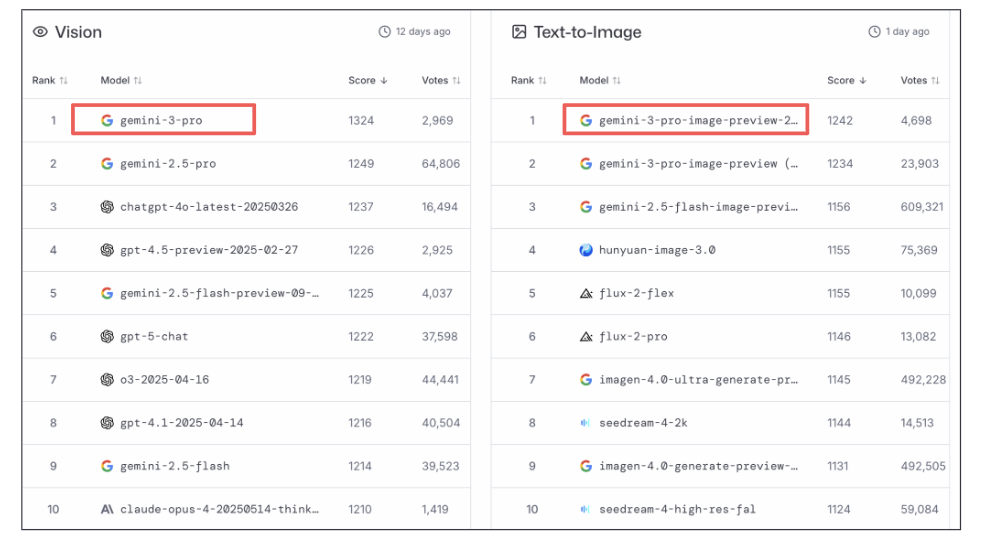
There are several technical talking points, but what I am paying special attention to is its high capability in image processing and generation. As shown in the leaderboard (3) below, its strength is overwhelming and unrivaled. The famous image generation app Nano Banana Pro is officially named Gemini 3-Pro-Image, and its high scores truly stand out.

                        Leaderboard

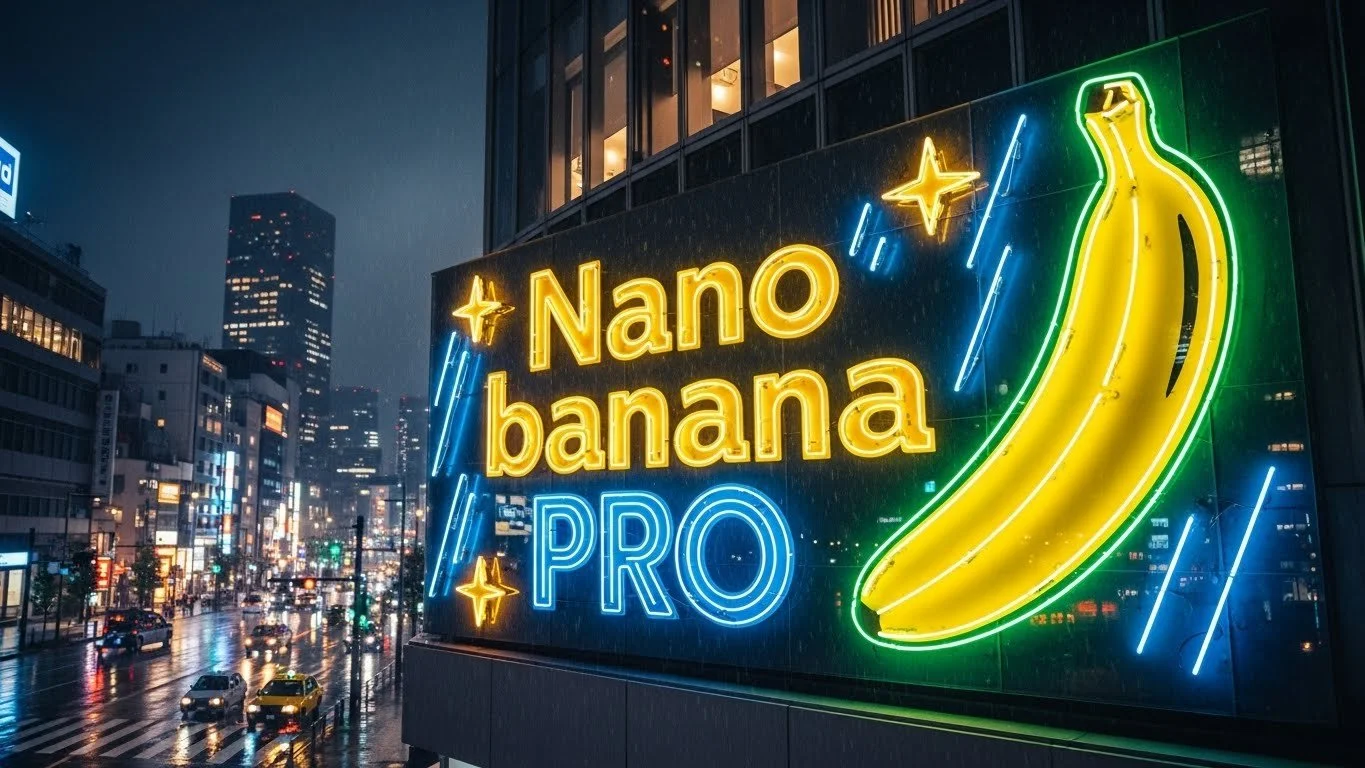
When considering individual customers, the ability to easily generate and edit images exactly as envisioned is crucial and can serve as a "killer app." I feel that once individuals experience the technical level of Gemini 3, they will find it difficult to easily switch back to competitor apps. The image below was generated using Nano Banana Pro. As you can see, it has become easy to render both English and Japanese text together on an image. Previously, Japanese text was often incomplete or incomprehensible, so it was quite moving to see clean Japanese generated for the first time.

                   Image generated by Nano Banana Pro


3. The Generative AI Market in 2026

With Sam Altman issuing a CODE RED, I believe OpenAI will allocate significant development resources to improving the model itself and will frantically work to close this gap in the image generation field. On the other hand, Google, armed with Gemini 3, possesses several multimodal generative AI models beyond just Nano Banana Pro, and I expect them to leverage that expertise to aim for further breakthroughs.

In particular, generative AI capable of simulation using 3D structures—known as World Models—will likely influence Large Language Models (LLMs) as well, solidifying Google's competitive advantage. One has to admit that Google, which owns YouTube, is incredibly strong in this field. It looks like 2026 will be a year where we cannot take our eyes off how OpenAI launches its counterattack.


How was it? While there are several other players creating generative AI, I believe the industry style will involve companies defining their own positions within the context of the "OpenAI vs. Google" battle. Therefore, the outcome of OpenAI vs. Google is extremely important for all AI-related companies. I would like to write another blog post on this same theme if the opportunity arises.

That’s all for today. Stay tuned!


You can enjoy our video news ToshiStats-AI from this link, too!


1) Sam Altman’s ‘Code Red’ Memo Urges ChatGPT Improvements Amid Growing Google Threat, Reports Say, Forbes, 2 Dec 2025
2) A new era of intelligence with Gemini 3, Google, 18 Nov 2025
3)  Leaderboard Overview


Copyright © 2025 Toshifumi Kuga. All right reserved

Notice: ToshiStats Co., Ltd. and I do not accept any responsibility or liability for loss or damage occasioned to any person or property through using materials, instructions, methods, algorithms or ideas contained herein, or acting or refraining from acting as a result of such use. ToshiStats Co., Ltd. and I expressly disclaim all implied warranties, including merchantability or fitness for any particular purpose. There will be no duty on ToshiStats Co., Ltd. and me to correct any errors or defects in the codes and the software.

Game Changer: How Nano Banana Pro is Redefining Digital Marketing!

Just fresh off the heels of last week's new model release, Google has debuted yet another new image generation model: Nano Banana Pro (Gemini 3 Pro Image). Rumors on the street say it boasts incredible performance. So, let's dive in and test it out to see its potential capabilities.


1. The Latest Tokyo Fashion Trends

Fashion evolves with every season, and keeping up with the trends can be a challenge. However, the internet is overflowing with the latest style information. I figured that by feeding this real-time data into generative AI, we could generate images of models wearing the styles currently in vogue. Let's give it a try. Below is the original image of the model. She is wearing an outfit typical of Japanese autumn.

Original Image

I fed this original image and the prompt "Perform Google Search for current Tokyo fashion trends for 20s lady and apply that style to the model in the attached photo. 4 images are needed." into Nano Banana Pro.

Generated Images

The same model appears in all four images, maintaining consistency. Furthermore, the latest fashion trends have been incorporated thanks to Google Search. This is wonderful. Nano Banana Pro's Grounding feature using Google Search is excellent. As the model updates in the future, we can expect the accuracy of capturing trendy fashion to improve even further.


2. Creating a Signature Cafe Menu

Next, I want to devise a set menu featuring shortcake and coffee for opening a cafe in Ashiya, a high-end residential area in Japan. For this one too, I prepared a prompt to generate the image after researching currently popular cakes using Google Search.

"I am opening a cafe in Ashiya, Japan, featuring a fruit shortcake and coffee set as the signature dish. Use Google Search to identify current cake trends in Ashiya City. Then, create a high-quality menu image for this set that includes a description and price in English, incorporating the local trends."

I generated the following Japanese and English versions of the menu.

English Version

Japanese Version

Both the Japanese and English text are perfect. I think this is a huge leap forward, especially since AI image generation has struggled to correctly render local languages like Japanese until now. I’m sure it will work well with other local languages too. It looks like Nano Banana Pro will be able to perform globally, regardless of language.


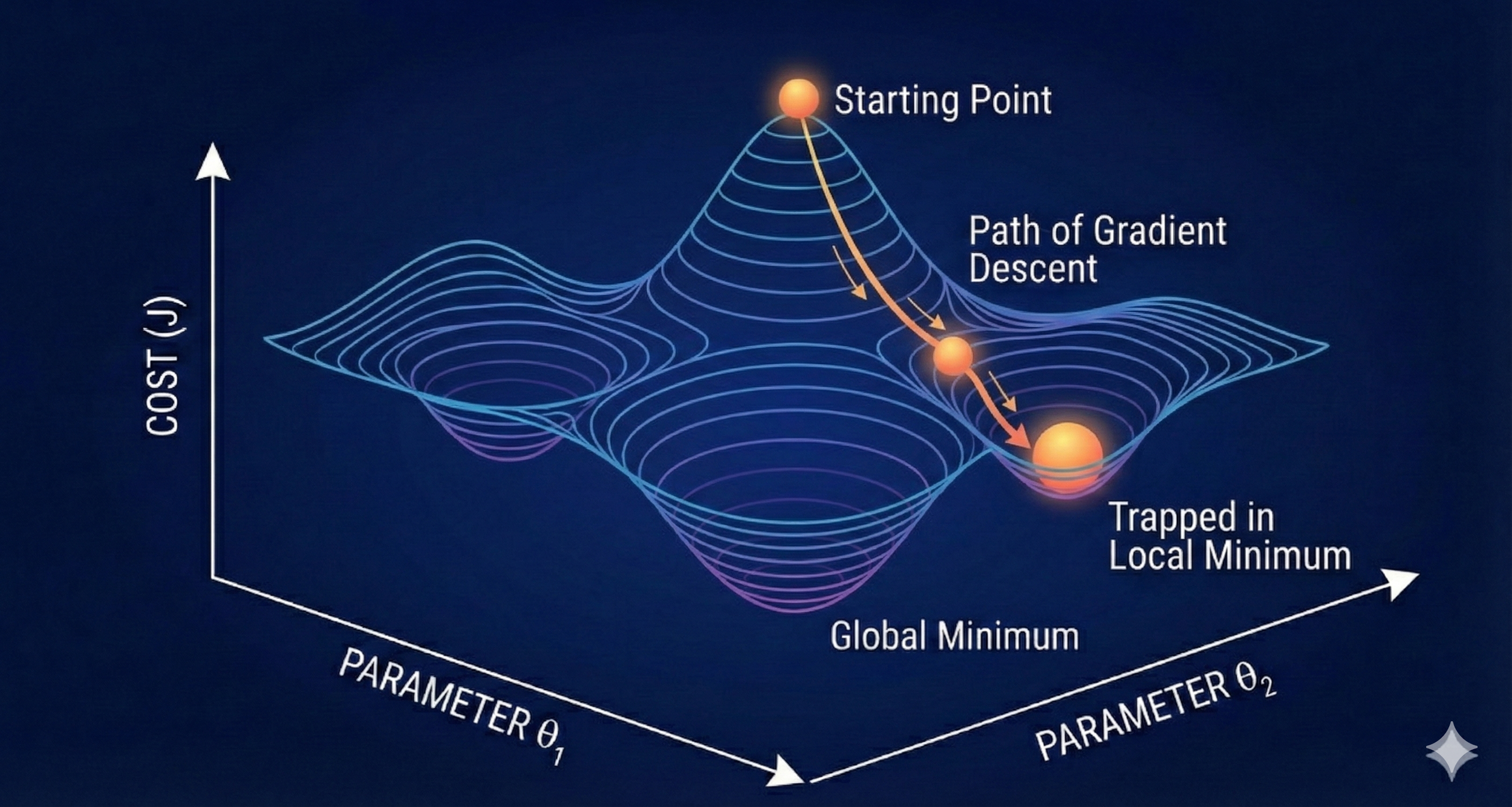
3. 3D Visualization of Loss Functions

Raising the abstraction level a bit, I want to execute a 3D visualization of a loss function—a topic often discussed when building targeting models for marketing—and clearly explain the concept of the gradient descent method. Nano Banana Pro can understand even theoretical and highly abstract phenomena like loss functions and map them in 3D. Below is the result. You can see at a glance how the parameters get stuck in a local minimum and cannot reach the point where the loss function is at its global minimum. Amazing.

Gradient Descent Method


How was it? Even from these few experiments, the excellence of Nano Banana Pro is clear. I have a hunch that Nano Banana Pro is going to change the very methods of digital marketing. I felt particularly strong potential in the Grounding feature using Google Search. I plan to cover Nano Banana Pro again in the near future.

That’s all for today. Stay tuned!


You can enjoy our video news ToshiStats-AI from this link, too!


1) Introducing Nano Banana Pro, Google, 20 Nov 2025


Copyright © 2025 Toshifumi Kuga. All right reserved

Notice: ToshiStats Co., Ltd. and I do not accept any responsibility or liability for loss or damage occasioned to any person or property through using materials, instructions, methods, algorithms or ideas contained herein, or acting or refraining from acting as a result of such use. ToshiStats Co., Ltd. and I expressly disclaim all implied warranties, including merchantability or fitness for any particular purpose. There will be no duty on ToshiStats Co., Ltd. and me to correct any errors or defects in the codes and the software.







Google Antigravity: The Game Changer for Software Development in the Agent-First Era

Google has unveiled Gemini 3.0, its new generative AI, and "Antigravity" (1), a next-gen IDE powered by it. Google states that "Google Antigravity is our agentic development platform, evolving the IDE into the agent-first era," signaling a shift toward truly agent-centric development. Here, I’m going to task Antigravity with creating a "Bank Complaint Classification App." I want to actually run it to explore its potential.

                   Antigravity


1.Agentic Development with Antigravity

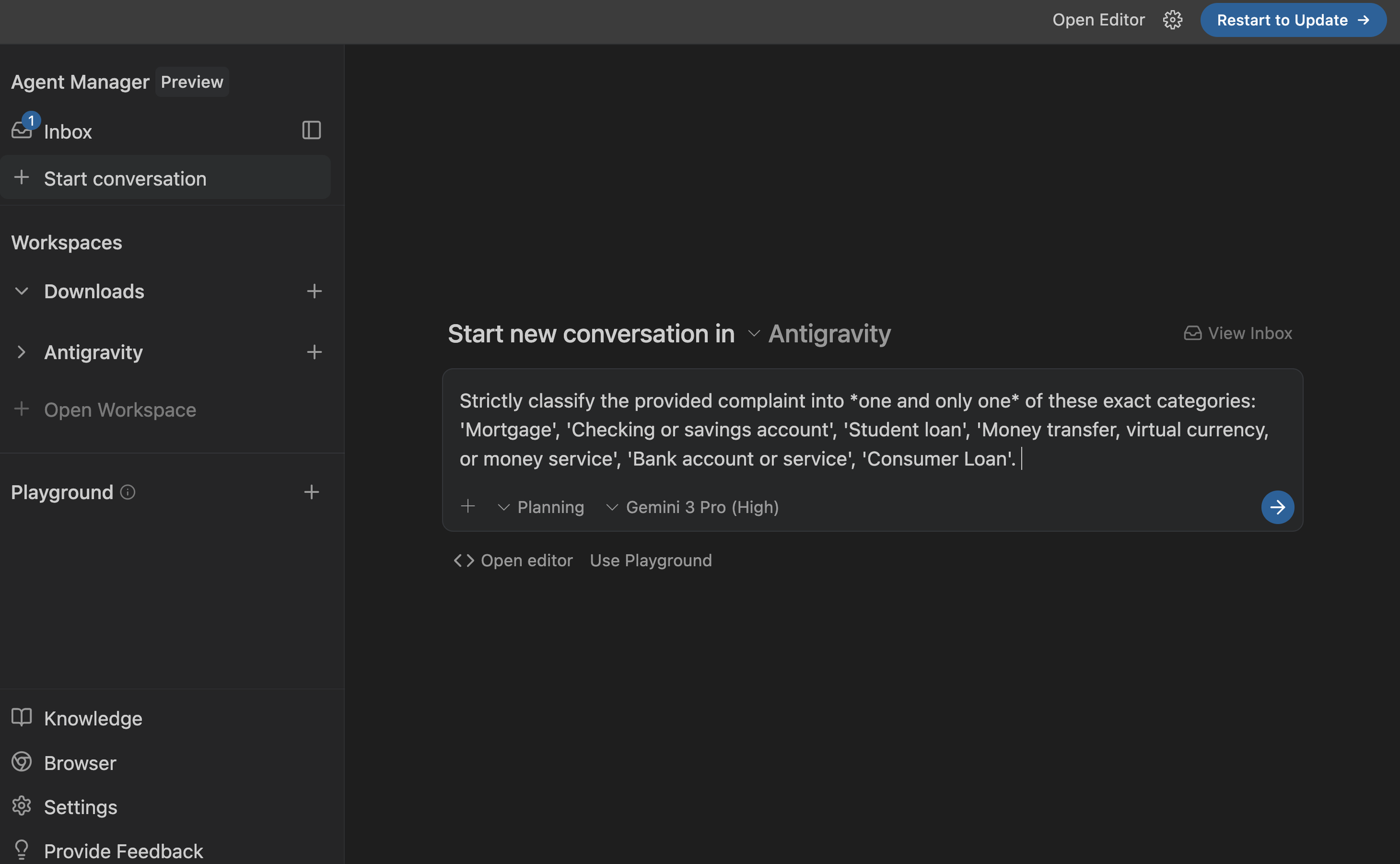
Antigravity is built on top of VS Code. If you are a VS Code user, the editor will look familiar, making it very approachable and easy to pick up. However, the real power of Antigravity lies in its dedicated interface for agentic development: the Agent Manager (shown below). Just enter a prompt into the box and run it to kick off "Vibe Coding." The prompt shown here is the very simple one I entered at the beginning of the development process. Antigravity also appears to be packed with various features designed to facilitate efficient communication with the Agent. For more details, please check the website (1).

                         Agent Manager


2. Prompt Refinement and Improvement

Just because you start "Vibe Coding" doesn't mean you'll get perfect code immediately. I started with a simple prompt this time as well, but the process proved to be more challenging than anticipated. While Gemini 3.0 Pro often demonstrates human-level capability when handling HTML and CSS for website building, the framework used for this app—Google ADK—is a brand-new agent development kit that just debuted in April 2025. Consequently, there are likely very few code examples available on the web, and I assume it hasn't been fully absorbed into Gemini 3.0's training data yet.

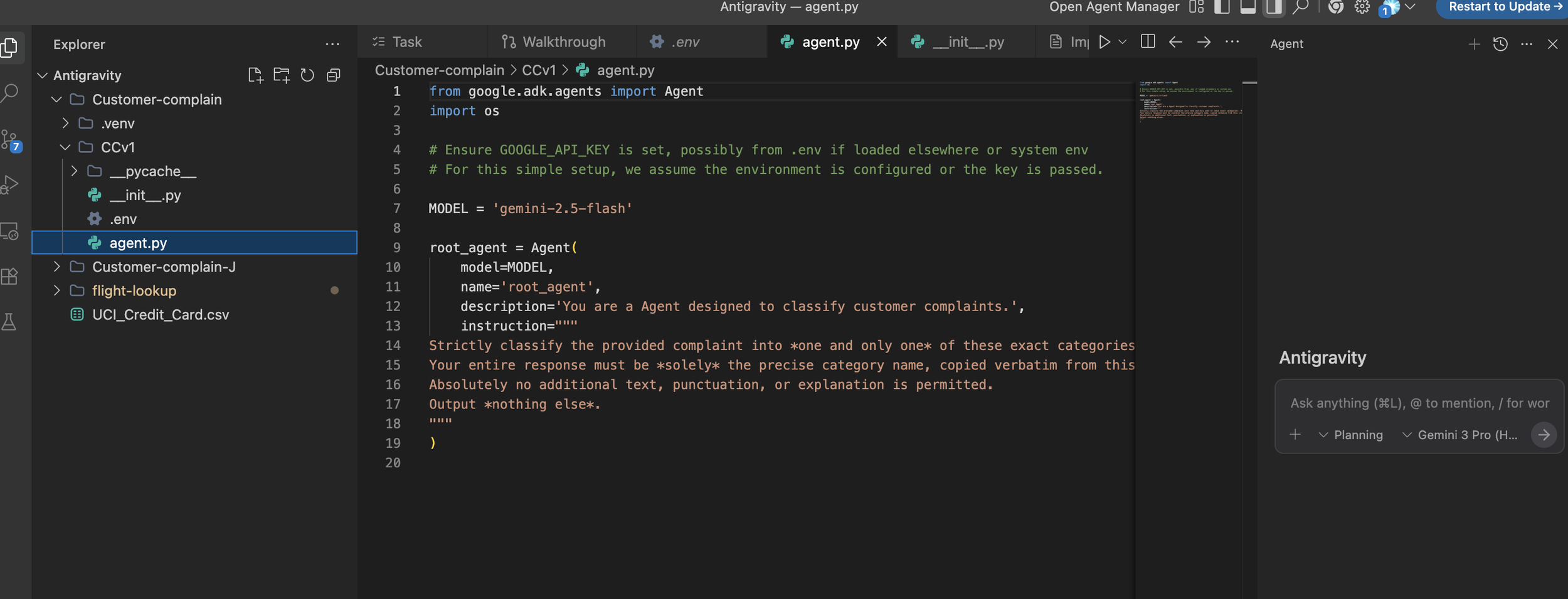
               Development with Google ADK

It was quite a struggle, but as shown above, I managed to build a fully functional app via "Vibe Coding." To generate these files, I relied solely on natural language instructions; I didn't write a single line of code directly in the editor. However, I did include simple code snippets within the prompts. This is a technique known as "few-shot learning," where you provide examples to guide the model. I believe this approach is highly effective when Vibe Coding with Gemini 3.0 for Google ADK development. While this might become unnecessary as Gemini 3 is updated in the future, it’s certainly a technique worth remembering for now.

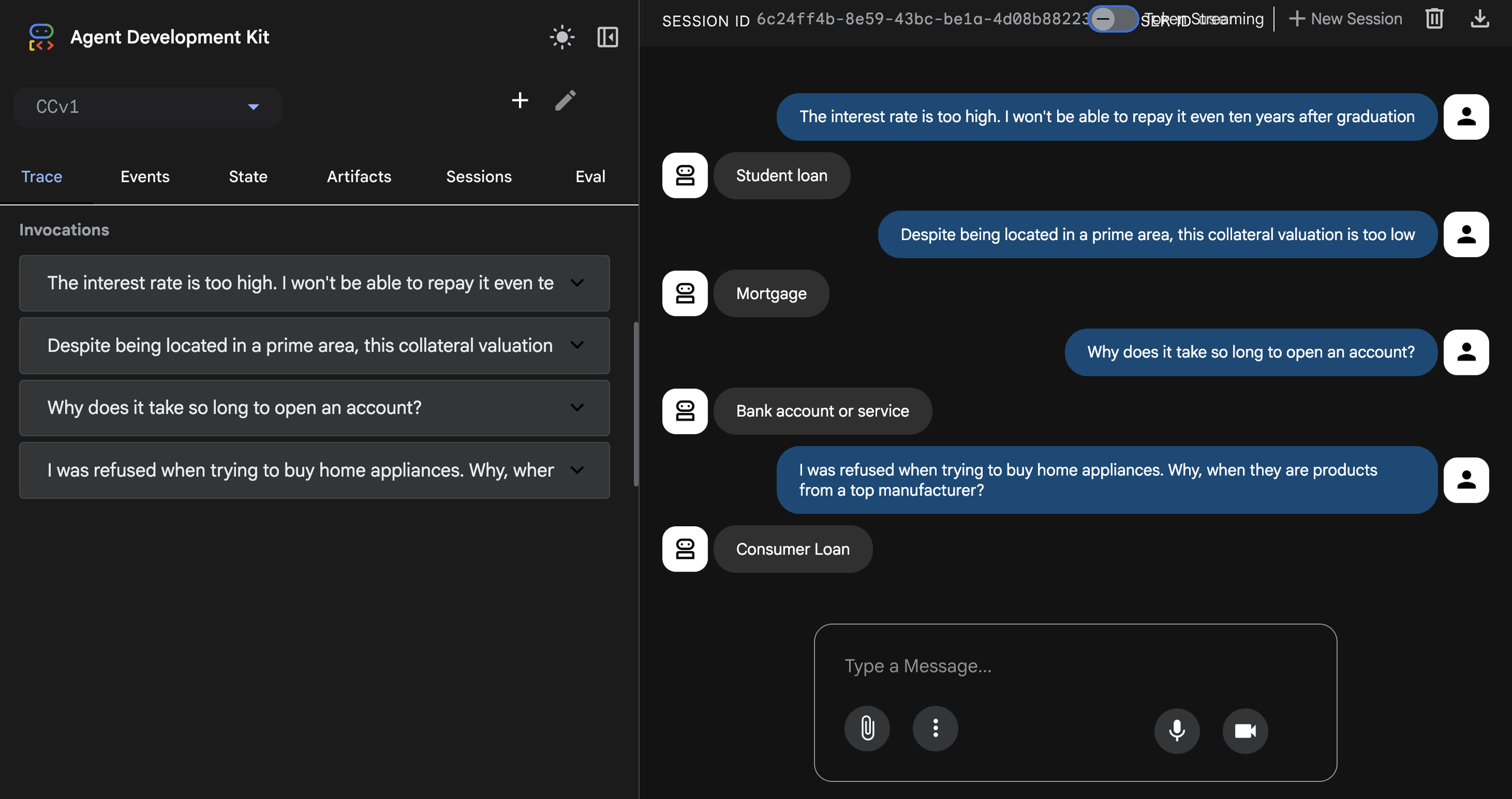
Bank Complaint Classification App using Google ADK

The screenshot above shows the "Bank Complaint Classification App" I developed. I verified its accuracy with some simple examples, and the results were excellent. It seems the internal prompts within the app were generated very effectively. Impressive work!


3. Summary of Building a Complaint Classification App with ADK

  • Total Time: 6 hours (starting from the Antigravity installation) to complete the app.

  • Execution: With the finalized prompt, the run time is just over a minute.

  • Manual Effort: The actual coding for Google ADK to make the app is only about a 20-minute task if done manually without vibe-coding.

  • Reasons for the Delay:

    • I had to iterate on the prompts several times because Gemini 3 is still unfamiliar with Google ADK

    • I had to explicitly instruct it on file structures and code syntax.

    • I was also using Antigravity for the first time.

  • Conclusion: It is manageable once you understand Gemini 3 Pro's behavior regarding Google ADK.


So, what do you think?

It took a little longer because I wasn't used to the new IDE yet, but the combination of Gemini 3.0 Pro and Antigravity was outstanding. I could really feel its high potential. Since the execution speed itself is fast, next time I plan to challenge myself by "Vibe Coding" a multi-agent app. Look forward to it! That's all for today. Stay tuned!


You can enjoy our video news ToshiStats-AI from this link, too!


1) Experience liftoff with the next-generation IDE, Google,  19 Nov 2025


Copyright © 2025 Toshifumi Kuga. All right reserved

Notice: ToshiStats Co., Ltd. and I do not accept any responsibility or liability for loss or damage occasioned to any person or property through using materials, instructions, methods, algorithms or ideas contained herein, or acting or refraining from acting as a result of such use. ToshiStats Co., Ltd. and I expressly disclaim all implied warranties, including merchantability or fitness for any particular purpose. There will be no duty on ToshiStats Co., Ltd. and me to correct any errors or defects in the codes and the software.